Drivers stage in Centennial Hills for the US-95 run north. They often leave with less range than that stretch spends. Charge Pro LV connects stranded drivers with independent local operators. Those operators bring a 240-volt Level 2 source to the car. The operator quotes you first, then bills you directly.
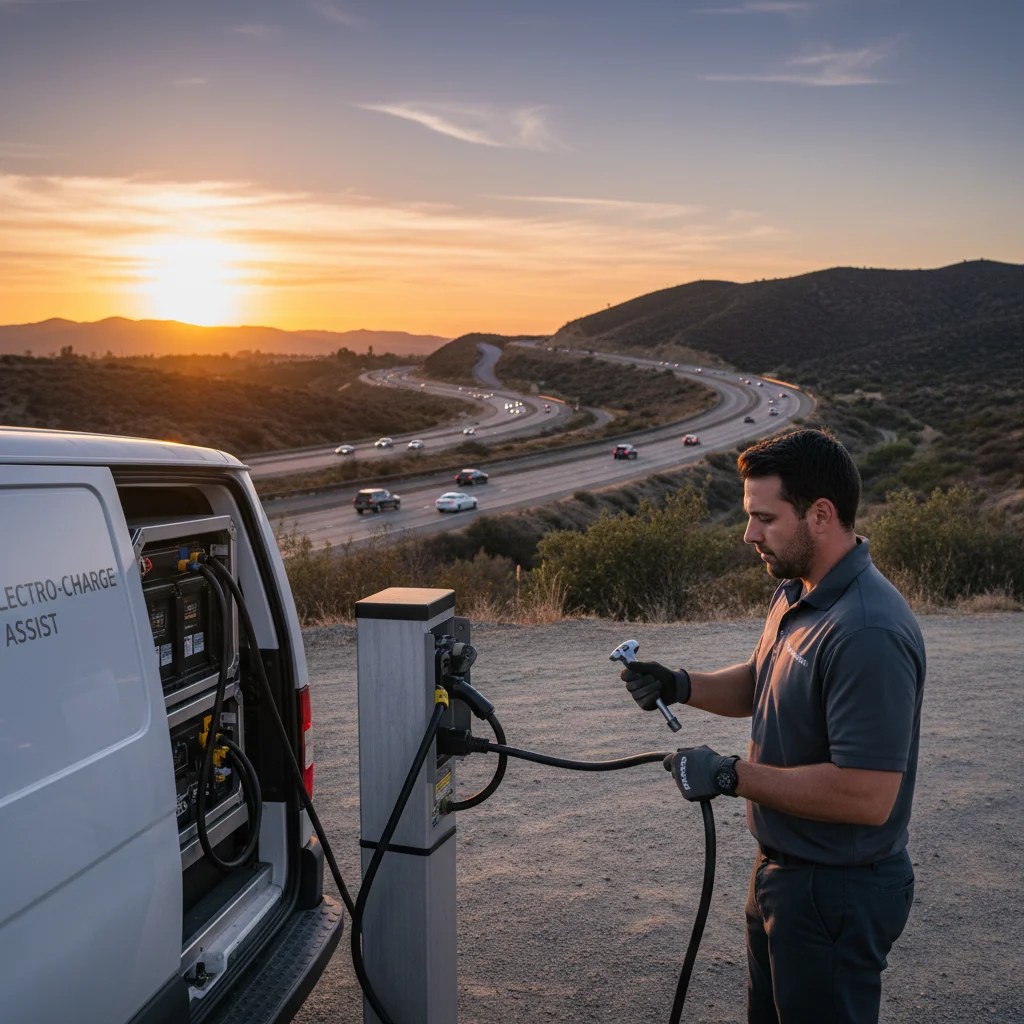
The last built-up streets before the north run
Centennial Hills sits in the far northwest Las Vegas Valley. It sits below the 215 and US-95 junction. That’s the last built-up pocket before US-95 continues toward Indian Springs. Drivers treat these streets like a launch pad. They charge in a garage and stop for food. Then they point north with a buffer that looked fine on the dash.
Local ZIPs include 89129, 89131, 89149, and 89166. Centennial Hills isn’t its own Census place. Population figures roll into the parent city, so skip invented headcounts.
South of the junction, you’re still in valley traffic. East, the beltway carries you across the north rim. North, the houses thin and US-95 keeps going. Centennial Hills is where that shift is easy to miss. The last shopping center still feels like town. The last light still feels like cover. The north run only spends what the pack has left.
This isn’t the Red Rock climb out of Summerlin. It isn’t the I-15 drop toward Jean and Primm. People here aren’t surprised by a scenic loop. They’re surprised that a short-looking run north used more than the leftover bars. You staged in a neighborhood. You didn’t stage for an open highway in desert heat.
Heat and elevation spend the margin you thought you had
Valley heat is measured, not guessed. NWS records at KLAS show an average July high of 104.5F. About 78 days a year reach 100F or more. About 9.4 days reach 110F or more. The all-time record high is 120F, set on 2024-07-07. Recurrent Auto found about 5% range loss at 90F, then 17 to 18% at 100F. Cooling a hot cabin drew 3 to 5 kW. Holding that cabin later used about 1 kW. AAA, in May 2026, measured 8.5% range loss at 95F. Don’t pin any of those numbers on Tesla. Tesla didn’t publish a range-loss figure we could cite.
Centennial Hills sits on the northwest rim, not downtown. The airport heat island runs 5 to 15F warmer than outlying areas. Downtown and the east valley can run up to 11F hotter than the rim. That still doesn’t make a July afternoon mild here. A car that sat in a driveway soaks heat into the pack. You start the climate and you merge. You’ve already spent energy the dash treated as highway cruise.
Indian Springs sits at about 3,169 feet. The valley floor runs about 2,000 to 2,920 feet. You’re not climbing Mount Charleston, but you’re still going up. Creech Air Force Base is near Indian Springs on US-95. Work trips and through drives both stage in Centennial Hills. Both often leave with a thin cushion.
US-95 has no toll. Nevada has no toll roads, express lanes, or transponders. I-15, the 215, US-93, US-95, and I-11 are all free. The pavement doesn’t bill you, but the pack still does. If you’re already in the low teens, don’t roll north on hope. A mobile EV charging stop at the car can add miles while you’re still among houses.
Empty pack, or a 12V that won’t wake the car
The usual north-run stall is a traction pack that’s spent. Traffic on the 215 ate miles, and the climate ate more. You rounded Indian Springs down in your head. Then power limited, or the car stopped.
The other stall is the 12-volt battery. Computers, locks, and the charge door need that small battery. That’s true even when the big pack still holds energy. A dead 12V makes the car look finished. Screens stay dark, handles may not work, and the port may not open. Desert heat is hard on that battery. If it won’t wake on a Centennial Hills street, don’t assume you need a flatbed. Tesla 12V failure in valley heat is a common pattern, and not only on Teslas.
Operators we connect you with can jump a 12V on site. They can replace one when that’s the job. They also handle an empty pack. Teslas take a native NACS plug. Other EVs take CCS or J1772 through an adapter. Tesla and every major EV brand are in scope.
Keep hazards on if you’re on a shoulder, and stay out of live traffic. Get a pin you can share. Then sort pack versus 12V with the operator, not with a forum thread.
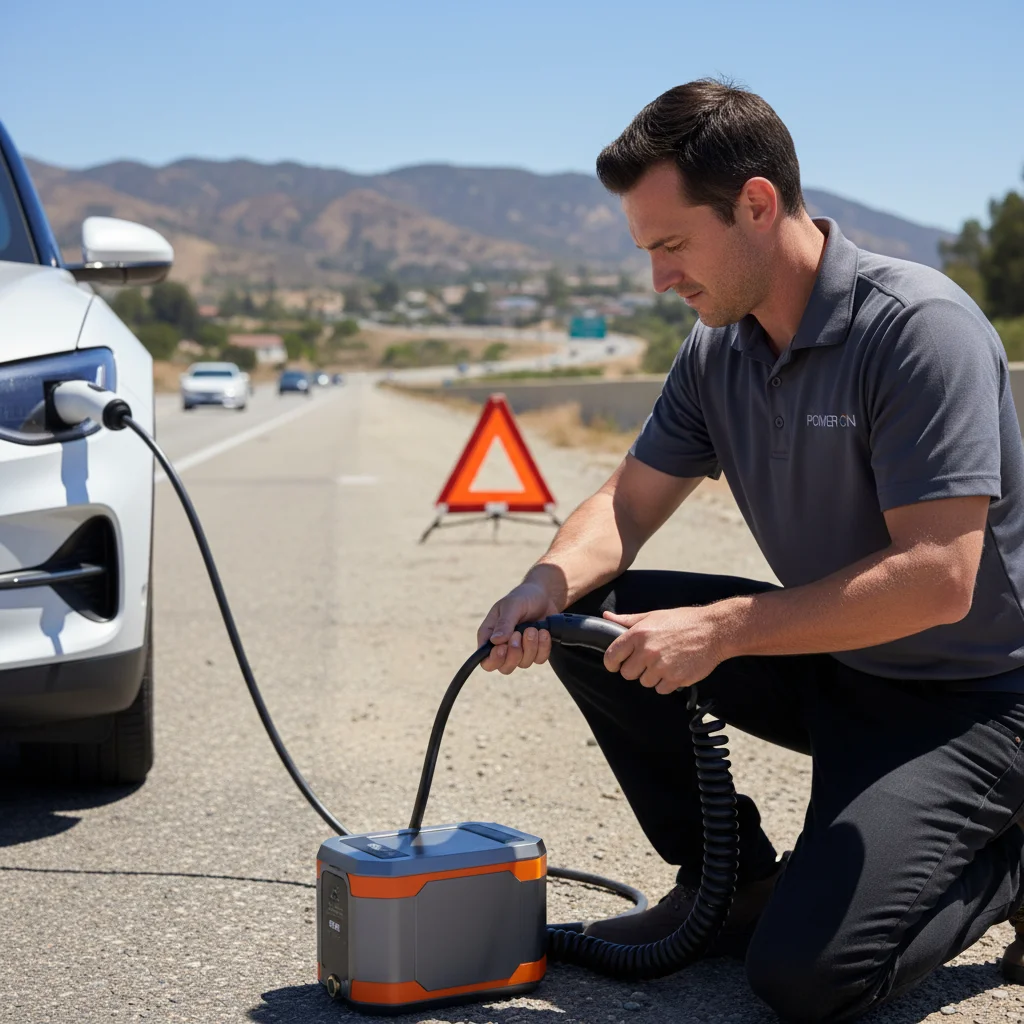
What a local operator brings, and what this brand doesn’t
Charge Pro LV is a referral line. We don’t own trucks, stock equipment, or employ technicians. We match you with an independent mobile rescue operator in the Las Vegas Valley. That operator quotes you before work starts and bills you directly.
They bring a 240-volt Level 2 source to the bumper. Typical charging adds about 10 to 20 miles of range. That takes about 15 to 30 minutes of plug time. That’s charging time, not an arrival promise. We don’t publish response windows. The operator sets the quote you actually accept.
Ten to twenty miles won’t finish a long north run by itself. It can get you off a shoulder and back into built-up Centennial Hills streets. It can also let you abort a trip that was already too thin. After a stall here, add range at the car before you force the next move.
If you’re already out on US-95 toward Indian Springs, the same idea holds. Don’t walk the highway. Share a pin and ask for a charge at the vehicle. Read an empty pack on US-95 near Indian Springs for the corridor version of this page.
Home charging is a different stack. NV Energy serves the Las Vegas Valley. Named programs include the Residential Electric Vehicle Recharge Rider. That EV charging window runs from 10:01pm to 8:00am. There’s also a Residential Managed Charging Program. Nevada has no state EV purchase rebate. None of that helps a car that’s already silent at the 215 junction.
Patrol, tows, and the statutes that apply on the shoulder
NDOT’s Freeway Service Patrol covers the busiest Las Vegas Valley freeways. Quality Towing operates it. GEICO sponsors it. Hours are 5:00am to 8:30pm, seven days a week. It’s free to motorists. Listed help includes tire changes, jump starts, fuel, minor fire suppression, and traffic control. NDOT’s published patrol materials don’t mention EV charging. That’s an observed silence, not proof a patrol truck can’t stop. You shouldn’t wait for a traction-pack fill. The program doesn’t advertise one.
Nevada 511 and nvroads.com show closures and cameras. The Nevada State Police Highway Patrol dispatches rotation tows. The cell shortcode is *647, and Southern Command is (702) 486-4100.
NRS 484B.440 covers a vehicle disabled so it can’t avoid stopping. That vehicle is exempt from the no-stopping-on-highway rule. The statute sets no time limit. NRS 484B.443 still lets law enforcement remove a disabled or abandoned vehicle. On freeways and primary highways, a vehicle is treated as abandoned after 24 hours. On other roads, that window is 72 hours, and the owner pays removal. Keep hazards on and don’t stand in a live lane.
Tow operators need a Nevada Transportation Authority certificate. Non-consent rates are operator-filed tariffs under NAC 706.408. There’s no single statewide maximum published here, and we won’t invent a tow bill. If the car can take a charge and the hardware still works, charge at the car. If a wheel, port, or drivetrain is broken, you need a tow. Mobile EV charging or a tow is the fork that matters.
Same north-run habit in the next neighborhoods
Aliante drivers make the same staging error, and so do people leaving Skye Canyon. Tule Springs sits in the same northwest corner. The grocery stop still feels like a full send-off. US-95 still asks for more than the leftover bars.
If the car died in a driveway, wait with it. If you’re on a freeway shoulder, stay out of traffic. Call Charge Pro LV for a match with a local operator. Valley-wide EV roadside assistance is the broader menu. This page is the Centennial Hills version: last built-up streets, then the north run.
Check the pack before you take the 215 north
Look at the estimate while you’re still in Centennial Hills. Look at 12V warnings too, because heat punishes both. The 215 and US-95 junction still has city behind it. That feeling fades a few lights later. Stage with more margin than an open-looking highway seems to need.
If you’re already stuck, call (702) 935-4699 instead of waiting on a guess. An independent operator quotes you, then charges or jumps at the car.