If your EV dies on US-95 toward Indian Springs, treat it as desert exposure, not a short urban wait. Pull fully onto the right shoulder, turn on your hazards, and stay with the car. Then call for a mobile Level 2 charge at the vehicle. Charge Pro LV connects stranded drivers with independent local operators. Indian Springs sits about 45 miles northwest of Las Vegas, near Creech Air Force Base, at about 3,169 feet. A low pack on this run leaves you in open country.
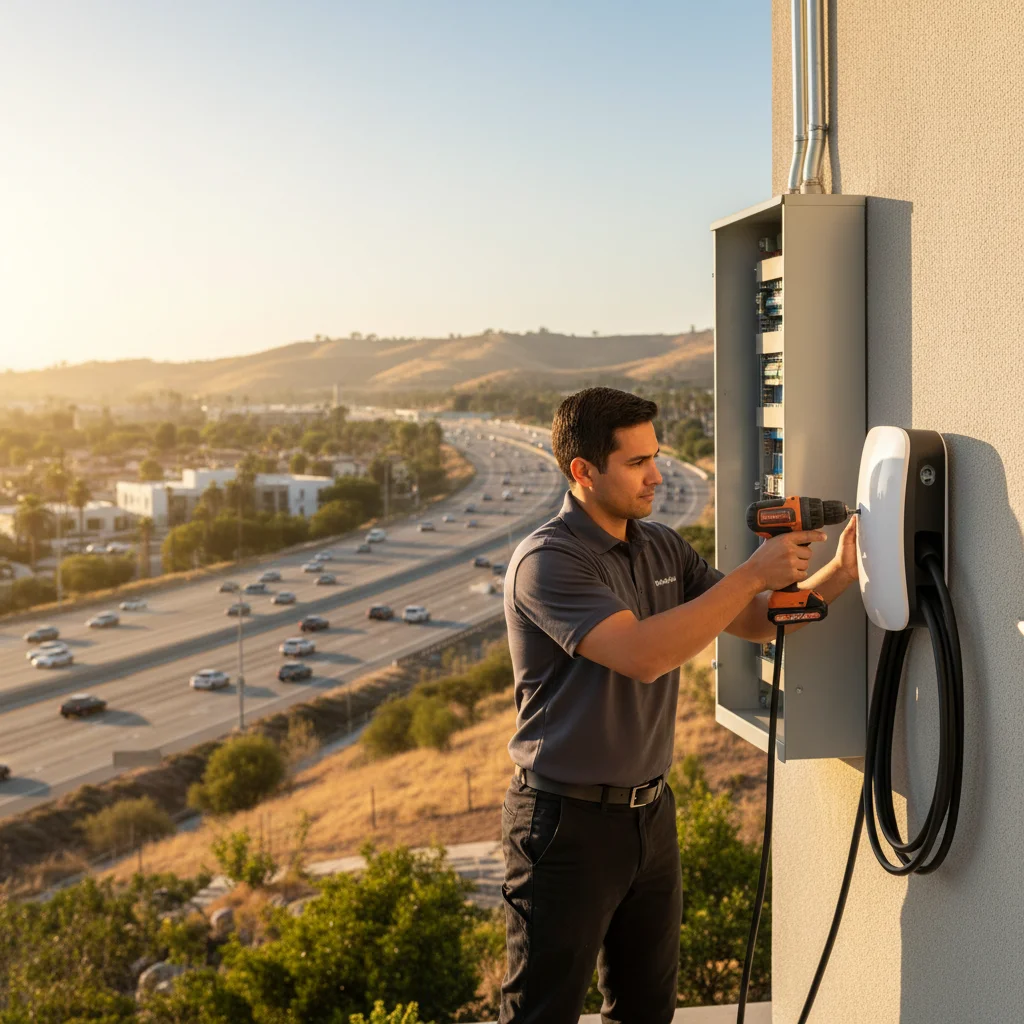
US-95 north is a long-dispatch stall
A dead EV on a valley freeway is still a problem. A dead EV on US-95 toward Indian Springs is a longer one. You’re leaving the dense street grid and heading toward a small desert town. ACS 2019-2023 puts Indian Springs at 736 residents, ZIP 89018. Creech Air Force Base sits nearby on the same highway.
This is the last real community stop many drivers hit on that north heading. People roll out through North Las Vegas, Centennial Hills, Aliante, Skye Canyon, or Tule Springs, then the fabric thins. If you started with a thin buffer, you’re already exposed.
Elevation tells part of the story. The valley floor sits about 2,000 to 2,920 feet. Indian Springs sits at about 3,169 feet. You’re not climbing Kyle Canyon. You’re still using more energy than a flat hop around Paradise. Dashboard estimates built on Strip traffic don’t always survive a long north cruise.
The utility is different too. Valley Electric Association serves Indian Springs, plus Blue Diamond and Sandy Valley. NV Energy covers most of the Las Vegas Valley. Don’t call an NV Energy EV desk about a stall in 89018. A shoulder rescue is still a mobile operator at the car.
US-95 has no tolls, and Nevada has no toll roads, express lanes, or transponder systems. That doesn’t shorten the miles. It only means you won’t hit a booth while you’re already low.
For town-level context, start with the Indian Springs page. If you’re already stopped, EV roadside assistance in Indian Springs is the local rescue path.
Heat spends the miles you thought you had
NWS Las Vegas records an average July high of 104.5F. About 78 days a year reach 100F or more. The official record high is 120F on July 7, 2024. Indian Springs is higher and more open than the valley floor. Treat heat as a range tax anyway.
Recurrent Auto found about 5% range loss at 90F and 17 to 18% at 100F. Cabin cooling can draw 3 to 5 kW to knock down a hot interior, versus about 1 kW to hold it. AAA’s May 2026 testing measured 8.5% range loss at 95F. None of those figures come from Tesla. No Tesla-published range-loss number turned up that we can cite.
A Model Y or an Ioniq 5 can arrive near Creech with less than the dash showed in Centennial Hills. AC on max, a headwind, and a slightly higher elevation add up. If the car was already under a quarter, this isn’t a hope-and-coast run.
January has a different bite. Average lows sit near 37F, with about 10 freeze nights a year. Recurrent Auto found about 70% of maximum range retained at 20F, and 78% at 32F. A north run on a cold morning still spends pack.
Monsoon months are July and August. Annual rain is only 4.18 inches, but it can dump into washes and underpasses. If you stalled in standing water, say that when you call. Don’t walk a wash at night.
If you’re still moving, stretching remaining range in valley heat is the decision sequence. Slow down and drop the cabin a notch. A controlled pull-off on a wide shoulder beats a silent coast in a travel lane.
Centennial Hills roadside help is where a lot of these drives begin. If the pack is already low in that neighborhood, fix it before US-95 opens up.
Stay with the car and make the location obvious
First job is staying out of the travel lane, not debugging the pack. Get the car as far right as it will go, and turn hazards on immediately. If you still have a few feet of motion, creep to a straighter shoulder instead of stopping on a curve.
Nevada gives you a legal landing. NRS 484B.440 covers a vehicle disabled so it can’t avoid stopping. That car is exempt from the no-stopping-on-highway rule. That section doesn’t set a time cap. NRS 484B.443 is the removal rule. Troopers may remove a disabled or abandoned vehicle. On freeways and primary highways, abandoned means 24 hours. On other roads it’s 72 hours. Don’t lock it and hitch south with a plan to come back tomorrow.
Nevada 511 and nvroads.com report conditions, closures, and cameras. The Nevada State Police Highway Patrol, formerly Nevada Highway Patrol, takes stranded reports. Use *647 from a cell. Southern Command is (702) 486-4100. Give direction of travel, the last thing you recognized, color, make, and whether anyone is with the car.
NDOT’s Freeway Service Patrol is a valley-freeway program. Quality Towing runs it, sponsored by GEICO, from 5:00am to 8:30pm, seven days a week. It offers tire changes, jump starts, fuel, minor fire suppression, and traffic control. None of NDOT’s published FSP materials mention electric vehicles, EV charging, or EV-specific service. That’s an observed silence, not a claim the patrol can’t help an EV. On the Indian Springs run, still start with 511 and *647. Don’t assume a valley freeway van is already routing to you.
If you get out, use the passenger door. The driver’s door opens toward traffic. Stand behind the right rear of the car, not between the car and the lane. Don’t walk toward Creech hoping a gate guard has a plug. It’s a military base, and town lights are easy to misjudge from the shoulder. Distances out here fool people who are used to the Strip.
You can stay in the car. That’s often the better choice if you’re close to live lanes. Sit away from the driver’s door and keep the hazards on. If a trooper wants you out, listen, then stay on the right.
Figure out whether the pack is empty or the 12-volt quit
A silent EV isn’t always at zero percent. The 12-volt battery runs the brains, and heat cooks that small battery. A car that won’t unlock or wake may still have pack energy. A failed charge session can mean the same thing. It may also have a dead 12-volt.
Operators in this network jump or replace a 12-volt on site. They also charge the high-voltage pack from a 240-volt Level 2 source. Tesla uses a native NACS plug. Most other EVs use CCS or J1772 through an adapter. A typical pack top-off is 10 to 20 miles of range in 15 to 30 minutes of charging. That’s time on the plug, not a clock for when someone arrives.
If the screen still shows a number, treat it as an empty-pack problem until proven otherwise. If the car is a brick and the app is dead, start with the 12-volt. Charge, jump, or tow walks through that fork without turning it into a guess in a live lane.
What a referral rescue actually looks like on this road
Charge Pro LV is a referral line for the Las Vegas Valley. It matches stranded EV drivers with independent mobile rescue operators. It doesn’t perform the work, own trucks, or employ technicians. It sets no prices and holds no license. The operator quotes you before starting and bills you directly.
That still gets you the hardware that matters. A 240-volt Level 2 source at the car, with NACS, CCS, or J1772. Tesla and every major EV brand. Enough range to leave the shoulder under your own power.
When you call, skip the story about the whole day. Give northbound or southbound. Give Indian Springs, Creech, or the last north-valley place you knew. Give the percent if you have it, and the make. If the car won’t unlock, say that so they bring 12-volt gear.
For the in-valley version of an empty pack on a freeway, see out of charge on a Las Vegas Valley freeway. Same physics, different geography. US-95 toward Indian Springs is long-dispatch desert. The operator may be coming from the valley. Your job is to stay put and be findable.
Factory roadside and motor clubs are a separate path. They may send a tow or a jump. They may not send a charger. Confirm what is coming before you decline a local operator.
Towing is regulated. NRS 706.4463 and related sections cover certificates, release-at-scene rules, private-property tows, and notice. Non-consent rates sit under NAC 706.408 as operator-filed tariffs. There’s no statewide cap published here. If the car is still hooked and you want it down, the statute requires a release at the original location. You pay the operator’s set release fee. Don’t block a lane to argue it.
A mobile charge avoids most of that paper. You stay the driver, and you don’t inherit a storage clock. Ask for out-of-charge recovery when the pack is the problem.
Don’t start the north run on leftover commute miles
The stall is on US-95. The mistake is usually south of it. If you’re bound for Indian Springs from Summerlin, Spring Valley, or Henderson, you already spent valley heat before the desert even starts. If you live in North Las Vegas, you still need a real buffer. Leaving on a sliver of charge isn’t a plan.
There’s no Nevada EV purchase rebate, and no EV-specific DMV surcharge either. Clean Cars Nevada is in force from model year 2025. None of it puts a plug on the shoulder. Your buffer is the only policy that matters at 3,169 feet.
Home charging in Indian Springs is a Valley Electric Association question. Home charging in the valley is usually NV Energy. Those home programs don’t help a car that’s already silent on US-95. Don’t sit there comparing rate riders.
If the car can take a charge, add range and drive it off. If it can’t wake, fix the 12-volt. If it’s in a wash, a wreck, or a lane, the operator and the troopers will tell you it’s a tow. Believe the scene, not a hopeful pin on your phone.
Call Charge Pro LV at (702) 935-4699 to be matched with an independent operator. You’ll get a quote before any work starts. The operator bills you directly.
Frequently asked questions
What should I do first if the EV dies on US-95 toward Indian Springs?
Get fully onto the right shoulder and turn on the hazards. Stay with the car. Report the stall to Nevada 511 or the Highway Patrol at *647. Then call for a mobile Level 2 charge at the vehicle. Don’t walk toward Creech or into town lights you can’t measure. Indian Springs is a small US-95 community, about 45 miles northwest of Las Vegas. A low pack here is exposure, not a short wait on an urban ramp.
Can operators charge brands other than Tesla out here?
The operators we connect you with bring a 240-volt Level 2 source. Teslas use native NACS. Other EVs use a CCS or J1772 adapter. That covers Rivian, Hyundai, Kia, Ford, GM, Volkswagen, and most other plugs you’ll see. Tell them the make when you call so they roll with the right adapter. They can also jump or replace a dead 12-volt on site if the car won’t even wake.
Should I wait for a tow instead of charging on the shoulder?
If the car will accept a plug, a charge at the bumper usually beats a tow. A tow still makes sense after a crash, in water, or when the car can’t sit safely. Non-consent tow rates are operator-filed under NAC 706.408, and we don’t publish a number. Ask the mobile operator what the car needs once they see it.