Your EV died in a Winchester apartment stall after a hot day off the Strip. Charge Pro LV connects you with an independent local operator who can add range or wake a dead 12V at the car.
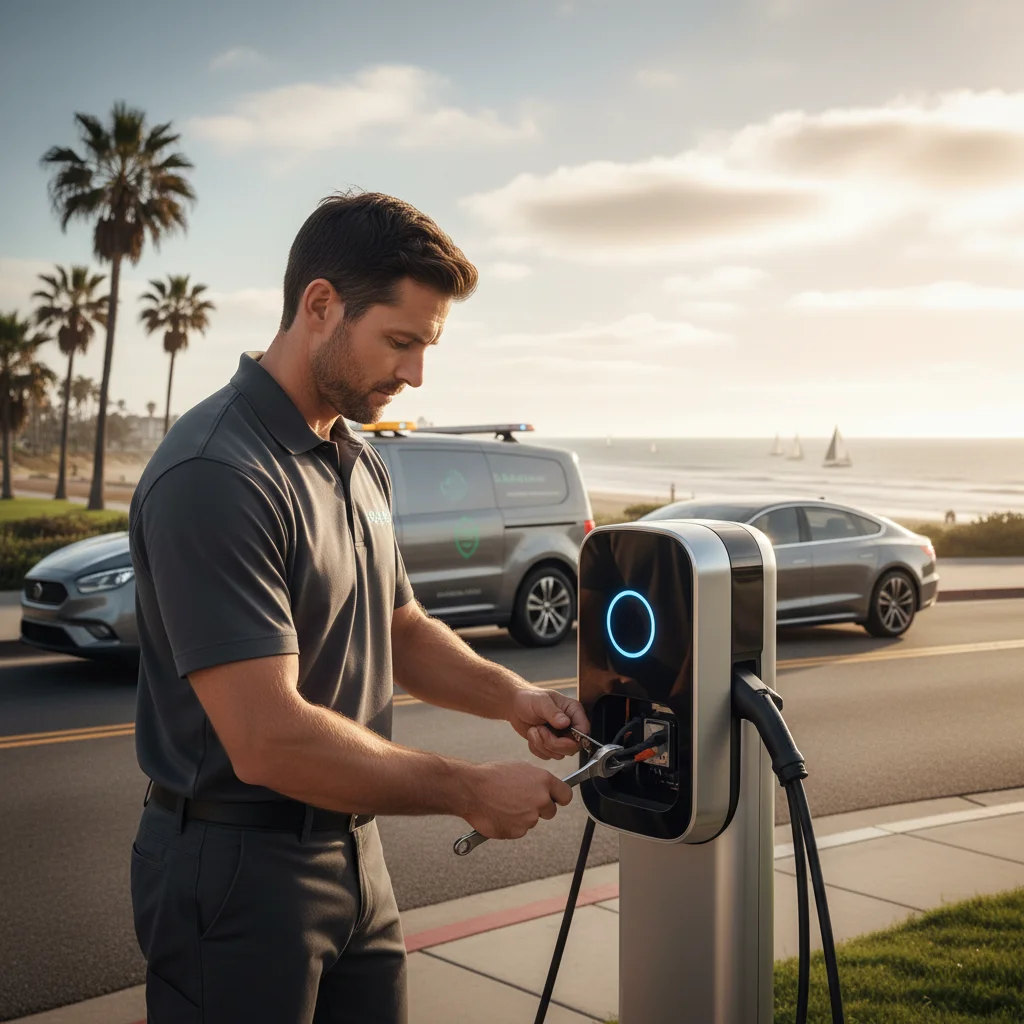
Winchester apartments were not built around a home plug
Winchester sits east of the Strip around Sunrise Hospital and the Boulevard. It’s unincorporated Clark County, not a pocket of the City of Las Vegas. Census ACS 2019-2023 counts about 37,774 people here. About 53.1% of the housing was built before 1980.
That vintage shows up the first night you park an EV. Pre-1980 apartments were wired for window units and a laundry room, not a 240-volt wall box. Clark County Title 30 requires EV-ready wiring in new construction. It doesn’t rewind a 1970s walk-up.
Plenty of Winchester drivers rent. They park in shared lots and live on public charging. There’s no driveway plug to top off while you sleep. NV Energy, Nevada Power Company, serves this whole community. The Residential Electric Vehicle Recharge Rider sets a charging window from 10:01pm to 8:00am. That rate only helps if you’ve got a place to plug in. Many Winchester buildings don’t.
NV Energy also names a Multifamily Charging program and Residential EV Charging Station Incentives. This page doesn’t publish dollar amounts. Confirm current rules with NV Energy before you count on a rebate. The Lower Income EV Rebate closed on 2023-06-30. Nevada has no state EV purchase rebate or tax credit. The Governor’s Office of Energy and the AFDC both confirm that absence.
So the overnight plan is a public stall, a workplace plug, or a partial charge. Convention weeks make that plan brittle. Crowds fill the garages. You leave with less buffer than you wanted. The next morning is a Strip shift, a visit at Sunrise Hospital, or a drop-off at Harry Reid International Airport.
If the building has no 240-volt outlet, mobile charging or a home battery when the apartment has no plug is the closer read.
This corridor runs hotter than the west rim
Winchester isn’t Summerlin. It isn’t the west-valley rim. NWS Las Vegas notes the airport can run 5 to 15F warmer than outlying areas. The east valley and downtown can run up to 11F hotter than the rim. This community sits in that hotter belt.
KLAS climate is the valley’s official yardstick. The average July high is 104.5F. About 78 days a year reach 100F or more. About 9.4 days reach 110F or more. The record high is 120F, set on 2024-07-07. Average January lows sit near 37F, with about 10 freeze nights. Annual rain is 4.18 inches. Monsoon storms in July and August can flood washes and underpasses. Heat is still the range story.
Recurrent Auto measured about 5% range loss at 90F and 17 to 18% at 100F. Cooling a hot cabin can draw 3 to 5 kW, versus about 1 kW to hold the temperature. AAA in May 2026 measured 8.5% range loss at 95F and 39.0% at 20F. Geotab found hot-climate batteries degrade about 0.4% per year faster. Phoenix-style desert heat was the worst case. No Tesla-published range-loss figure was located. Don’t treat the car’s own estimate as a heat study.
A Winchester driver who left with a comfortable buffer at dawn can watch it shrink by late afternoon. Cabin AC and stop-and-go on the Strip approach spend extra energy. So does a parked soak in an open lot. The west rim doesn’t spend it the same way.
The 12V battery ages in that same heat. It runs the computers, the locks, and the wake sequence. The traction pack can still hold miles. The car can still refuse to open.
For the heat-first version of this stall, see EV died in Winchester heat: mobile rescue off the Strip corridor.
Strip nights and airport sits drain the buffer
Winchester feeds the Strip. Parts of that resort corridor sit in Winchester and Paradise, both unincorporated. Drivers here also feed Harry Reid International Airport parking in Paradise. The airport’s own names for those decks are Terminal 1, Terminal 3, Short Term, Long Term, Economy, Remote Lot, Cell Phone Lot, and Reservation Parking.
Cars sit. That’s the pattern. A convention week at the Las Vegas Convention Center can leave the EV in a garage for a day or more. So can a night at Sphere or T-Mobile Arena, or a flight out of Harry Reid. Cabin modules keep sipping the 12V. The pack may have been fine when you parked. It may not wake when you come back.
Airport parking publishes free battery jump starts and tire inflation. Whether those lots have EV charging isn’t verified on the airport’s own site, so this page won’t claim it. A 12V jump at an airport post won’t add traction range if the high-voltage pack is empty.
If the car went quiet in those airport decks, Tesla dead in Harry Reid long-term parking walks the 12V-versus-pack split.
Resort and convention garages fill during big weeks. You circle. You take a farther stall. You skip a public charger because the line looks long. That isn’t a claim about missing stations. It’s a full garage and a hotter cabin. The car still needs port energy or a 12V wake when you return.
Empty pack or a 12V that won’t wake
From the sidewalk those two failures look the same. Dark dash. No door. No ready chime.
An empty traction pack needs energy at the charge port. The operators this line connects you with bring a 240V Level 2 source to the car. Tesla and other NACS cars take a native NACS plug. CCS and J1772 cars take an adapter. A typical session adds 10 to 20 miles of range in 15 to 30 minutes of charging. That window is time on the plug. It isn’t an arrival estimate.
A dead 12V needs a jump or a replacement on site. Charging the port won’t boot the computers if that small battery is flat. Operators handle Tesla and every major EV brand on both jobs.
EV roadside assistance is the stall itself. Mobile EV charging is the empty-pack path.
Stay out of the high-voltage system. You’re not probing orange cables. You’re calling for an operator who already carries the right connector.
Lots, shoulders, and Nevada rules
Most Winchester stalls are apartment lots, hospital-area streets, and garage decks. If the car is in a safe stall, stay with it. Hazards on. Have the make, model, and nearest cross street ready. The operator uses that to quote before any work starts.
If you’re on a freeway shoulder and the spot is dangerous, call 911 first. NRS 484B.440 exempts a vehicle that can’t avoid stopping from the no-stopping-on-highway rule. It sets no clock on how long the car may remain. NRS 484B.443 still lets law enforcement remove a disabled or abandoned vehicle. On freeways and primary highways, abandoned treatment can start after 24 hours. On other roads it’s 72 hours. The owner pays removal.
The NDOT Freeway Service Patrol runs on the valley’s busiest freeways. Hours are 5:00am to 8:30pm, seven days a week. Quality Towing operates it. GEICO sponsors it. It offers tire changes, jump starts, fuel, minor fire suppression, and traffic control. NDOT’s published patrol materials don’t mention electric vehicles, EV charging, or EV-specific service. That’s an observed silence in the brochure. It isn’t a claim the patrol can’t touch an EV. Nevada 511 and nvroads.com show closures and cameras.
Nevada has no toll roads, express lanes, or transponder systems. I-15, I-215, US-93, US-95, and I-11 are free. I-15 HOV lanes run from Silverado Ranch to the Spaghetti Bowl. They need two-plus occupants, 6-8am and 4-6pm weekdays. There’s no single-occupant EV HOV exemption. The federal authorization expired 2025-09-30. None of that charges the car.
Non-consent tow rates are Nevada Transportation Authority tariffs under NAC 706.408. There’s no single statewide maximum on this site. Confirm any tow price with the company on scene.
Next-door places that share the same cars
A Winchester plate shows up in Paradise resort decks the same night. It shows up on Strip approaches and in Sunrise Manor lots. The census line isn’t a charging line.
The Winchester city page is the hub for this community. If you stalled one block into resort traffic, EV stalled on the Strip: what to do in resort traffic is the sibling.
What this line does, and what it doesn’t
Charge Pro LV is a referral line for the Las Vegas Valley. It matches stranded EV drivers with independent local mobile rescue operators. It doesn’t hold a trade license. It doesn’t own trucks, yards, or parts. It employs no technicians. It sets no prices. It publishes no business hours. It promises no arrival time.
The operator quotes you before starting and bills you directly. Ask for that quote before any cable goes in. If a figure isn’t on the operator’s quote, it isn’t a fact on this page.
The US Department of Energy AFDC locator is the planning tool for public stalls on a normal day. Use it before you’re already at zero. It doesn’t roll a truck.
Frequently asked questions
Does Charge Pro LV serve Winchester?
Yes. Winchester is inside the Las Vegas Valley service area. The match is for apartment lots, hospital-area streets, and Strip-edge garages. An independent operator quotes the job before a charge or a 12V jump begins.
Why did the car die after it sat at a resort or the airport?
A multi-day sit in heat often kills the 12V first. Cabin modules keep drawing while you’re inside Sphere, a convention hall, or a terminal. The traction pack can still show range. The car still won’t wake. An empty pack is the other pattern, usually after public charging didn’t happen the night before.
Is a mobile charge better than a tow from a Winchester lot?
If the car is undamaged and the problem is energy or the 12V, charging or jumping at the stall is the direct fix. A tow relocates the car. You still need a wake or a charge after the hook. Tow when there’s crash damage, a drive-unit fault, or a high-voltage error that won’t clear.
If the EV is dead in Winchester, call (702) 935-4699. We’ll connect you with a local operator who quotes the work before it starts.