A GMC Sierra EV that coasts onto a valley shoulder still has a way out. A Level 2 source at the port typically adds 10 to 20 miles in 15 to 30 minutes of charging. That window is charging time, not a promise of when someone arrives. Those miles are usually enough to reach a safer stop, a home plug, or a public stall you already meant to use.
Charge Pro LV is a referral line for the Las Vegas Valley. We match stranded drivers with independent local mobile rescue operators. We don’t own trucks, employ technicians, or set prices. The operator quotes you before any work starts and bills you directly.
Why a Sierra EV runs short on valley roads
The brochure range assumes a light load, mild air, and a flat loop. Valley driving is rarely that. The floor sits about 2,000 to 2,920 feet. Then the roads leave it. Summerlin climbs toward about 3,500 feet, and higher near Red Rock Canyon. Kyle Canyon Road heads for Mount Charleston, where the town sits about 7,506 feet. Railroad Pass toward Boulder City is about 2,360 feet. Jean is about 2,841 feet. Primm is about 2,618 feet. Indian Springs, up US-95, is about 3,169 feet. Each grade spends energy on the way up. Regen returns some of it on the way down. It doesn’t return all of it.
Heat does the rest. NWS Las Vegas records an average July high of 104.5F. About 78 days a year hit 100F or more. About 9.4 days hit 110F or more. The official all-time record is 120F on July 7, 2024. The airport runs 5 to 15F warmer than outlying areas. The east valley and downtown can run up to 11F hotter than the rim. Your Sierra EV spends energy cooling the pack and the cabin at the same time.
Recurrent Auto found about 5% range loss at 90F and 17 to 18% at 100F. Cabin air conditioning can draw 3 to 5 kW to cool a hot interior, versus about 1 kW to hold it. AAA, in May 2026, measured 8.5% range loss at 95F. Those figures aren’t GMC numbers. Don’t treat them as a Sierra EV spec. They’re published heat studies, and they match what a July afternoon feels like on I-15.
Winter is the quieter version of the same problem. Average January low is 37F, with about 10 freeze nights. Recurrent Auto found about 70% of maximum range retained at 20F and 78% at 32F. AAA measured 39.0% range loss at 20F. Cabin heat and a cold pack both tax the same battery. A Sierra EV that sat outside overnight in North Las Vegas can wake up with a shorter number than you parked with.
Payload and towing pile on. The Sierra EV is a truck. Bed load, a trailer, and a headwind on I-15 south toward Jean all raise consumption. Freeway speed on I-15, I-215, CC-215, US-95, US-93, or I-11 does the same. There are no toll roads, express lanes, or transponder systems in Nevada. You’re not paying a lane. You’re still paying in kilowatt-hours when you hold highway speed in July.
Accessory draw is quieter and still real. Climate control, the screens, and any onboard outlets for tools all nibble the same pack. GM’s ProPower-style outlets on these trucks are for jobsite loads and camp gear. They’re not a plan for filling another EV on the shoulder. If you want the longer take on that idea, read Can one EV charge another when you’re both low.
Empty pack or a truck that won’t wake
Not every dead Sierra EV is out of traction energy. Many EVs look fully dead when the 12-volt battery is down. Locks, screens, and the computers that close the contactors all ride that small battery. Hazard lights may still work for a while. They may not.
If the truck won’t unlock, won’t show a display, and won’t accept a plug, tell the operator that. A 12-volt jump or replacement on site is a different job than a pack top-up. If the screens are alive, the range reads zero or near zero, and the truck rolled to a stop under its own power, you’re in out-of-charge territory. That’s the case this page is for.
Watch what the truck does on the way down. Power often fades before a full stop. Acceleration gets soft. Top speed may be capped. Climate control and infotainment can shut off to save what’s left for motion. Some EVs offer a short limp stretch at low speed. Use that stretch only to leave a live lane, not to hunt a stall across town.
Don’t guess with a hardware-store jump pack on the high-voltage system. You’re not jumping the big pack. You’re either waking 12-volt electronics or adding AC at the charge port. If you’re unsure which failure you have, say so when you call. The operator would rather hear both symptoms than the wrong one.
First minutes on a valley shoulder
When the low-charge warnings stack up, pick a safe place before the truck quits. Hazards on. Get fully out of the travel lane if you can. On I-15 through Enterprise, near Silverado Ranch, or through North Las Vegas, that shoulder is a live lane of heat and traffic. Stay in the cab unless the vehicle is unsafe. If you must exit, move well away from traffic.
Note landmarks a dispatcher can use. Mile markers help. So do named exits. “Southbound I-15 near Jean” is better than “somewhere on 15.” “CC-215 by Summerlin” is better than “the beltway.” The Strip sits in unincorporated Paradise and Winchester, not inside the City of Las Vegas. Saying “Paradise, west of Las Vegas Boulevard” is more useful than “Vegas.”
If you still have a sliver of motion, a parking lot beats a freeway lane. Allegiant Stadium lots after a game, Harry Reid long-term parking, a resort garage in Paradise, or a warehouse dock off the south Strip are all places a truck can sit still. Harry Reid parking publishes free battery jumps and tire inflation at (702) 261-5122. Whether those lots have EV charging isn’t something the airport’s site confirms, so don’t plan on a plug there.
Nevada 511 and nvroads.com report closures, cameras, and road conditions. The Nevada State Police Highway Patrol Southern Command is (702) 486-4100. Cell shortcode *647 reaches that dispatch path. Those numbers are for safety and tows, not for a Level 2 charge at the Sierra.
For the freeway version of this moment, see Out of charge on a valley freeway: what to do next.
What Nevada law says while you sit there
NRS 484B.440 covers a vehicle disabled so it can’t avoid stopping. That vehicle is exempt from the no-stopping-on-highway rule. The statute doesn’t set a time limit for how long it may remain.
NRS 484B.443 is the other half. Law enforcement may remove a disabled or abandoned vehicle. On freeways and primary highways, a vehicle is treated as abandoned after 24 hours. On other roads it’s 72 hours. The owner pays for that removal.
Tow operators in Nevada need a Nevada Transportation Authority certificate under NRS 706.4463 and related sections. If a still-hooked vehicle can be released at the original location, the operator charges that operator’s set release fee. Non-consent tow rates are operator-filed tariffs under NAC 706.408. There’s no single statewide maximum on this site, and we don’t publish a figure.
None of that is a reason to linger in a live lane. It’s a reason not to panic-tow a working EV just because a clock is in your head.
The NDOT Freeway Service Patrol covers the most-traveled valley freeways. Quality Towing operates it. GEICO sponsors it. Hours are 5:00 a.m. to 8:30 p.m., seven days a week. It’s free to motorists. The patrol handles tire changes, jump starts, fuel, minor fire suppression, and traffic control. NDOT says it clears about 55,000 incidents a year statewide, about 31,500 in Las Vegas. None of NDOT’s published patrol materials mention electric vehicles, EV charging, or EV-specific service. That’s an observed silence: the patrol doesn’t advertise EV charging. Don’t read it as “the patrol can’t help an EV.” A 12-volt jump might still sit in the ordinary toolkit. A 240-volt top-up of a Sierra EV pack isn’t what those flyers describe.
What GMC Sierra EV emergency charging looks like at the bumper
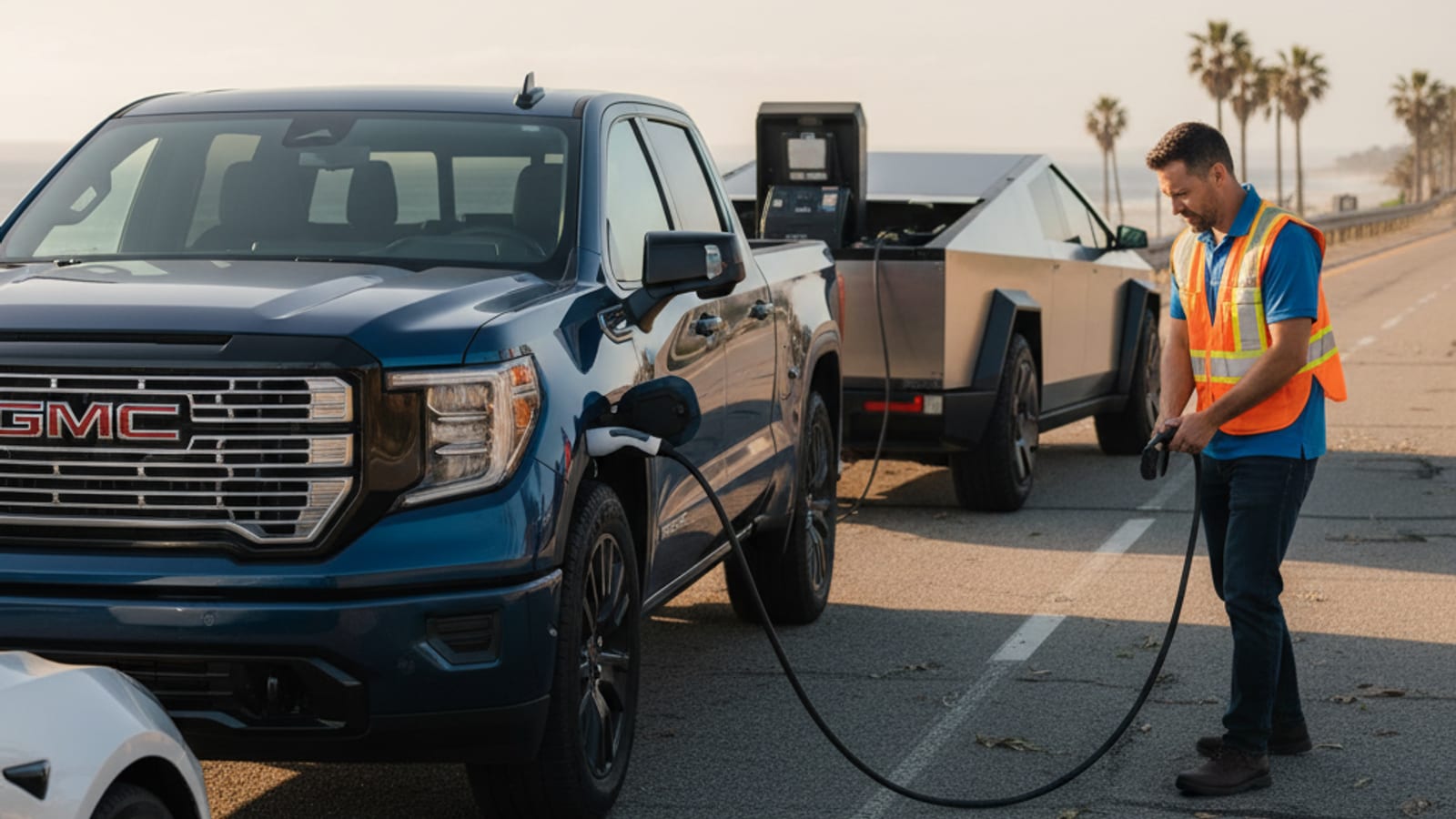
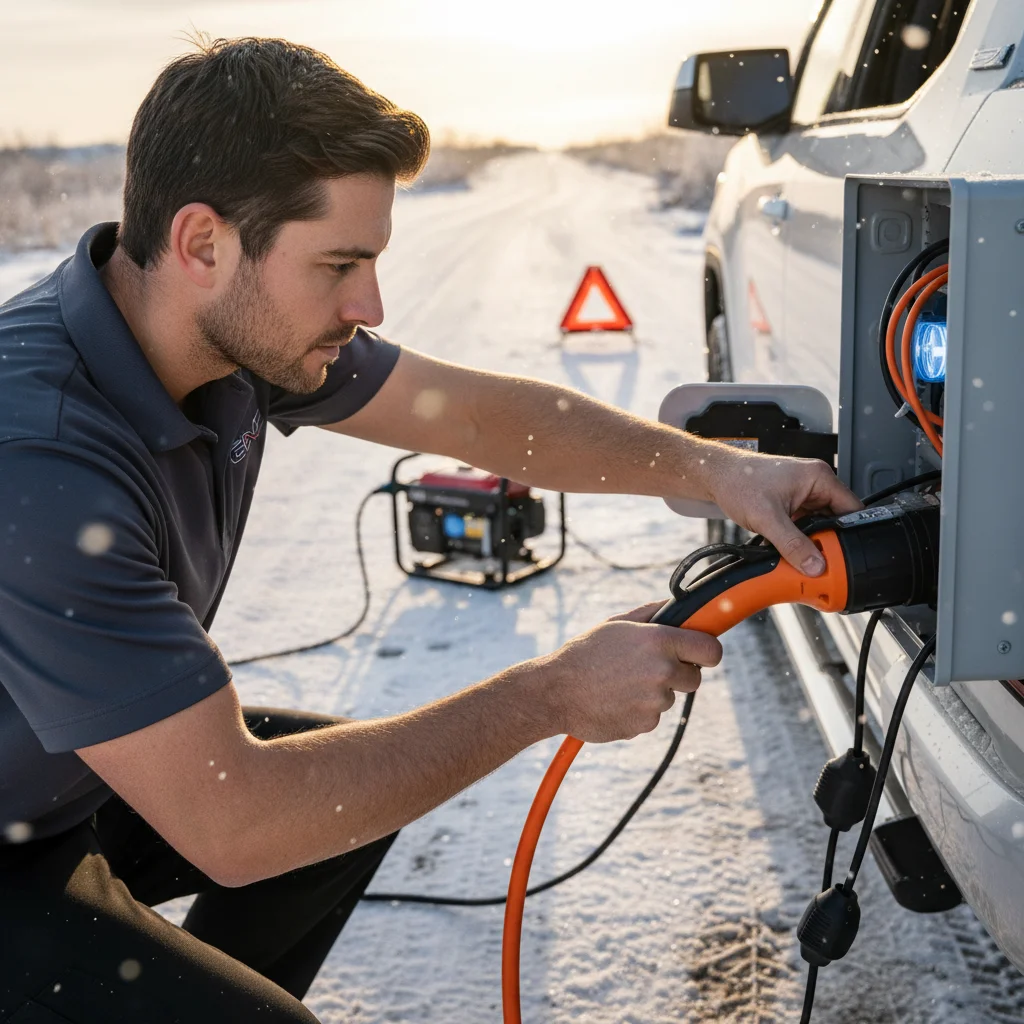
Mobile EV charging is the option that matches an empty pack on a shoulder. An independent operator brings a 240-volt Level 2 source to the truck. Operators typically carry a native NACS plug, plus CCS or J1772 adapters for non-Tesla EVs. A Sierra EV isn’t a Tesla. Tell the operator the model year and what the port looks like. GM has moved some trucks toward NACS. Older CCS ports still show up. The adapter on the truck matters more than a blog’s guess.
The job isn’t a full charge. The job is 10 to 20 miles in 15 to 30 minutes of charging so you can reach a safer stop. Home in Spring Valley. A garage in Henderson. A stall you already mapped in Summerlin. A public unit near Downtown. That’s out-of-charge recovery, not a fill-up.
Here’s what the session usually looks like, in order. You share the location, the model, and whether the screens still wake. The operator quotes before rolling into the work. You accept or you don’t. On arrival, the operator confirms the port, seats the right handle, and starts a Level 2 session. You stay with the truck. When the added miles are on the display, you unplug and move to the stop you named. Charge Pro LV doesn’t set that quote and doesn’t bill you for the work.
For how the truck itself is set up, What’s an EV charging truck, and who actually owns it here walks through the hardware without pretending this brand owns it. If you drive a Sierra EV, you’re in non-Tesla territory. The matching service page is Who helps a non-Tesla EV in the Las Vegas Valley.
Public stalls, portable cords, and a ride from a friend
If the screens still show a few miles, and you can creep to a stall you already trust, do that. Use the truck’s nav and a charging app. Filter for the connector you actually have. CCS and NACS aren’t interchangeable without the right adapter. We don’t publish charger counts for Clark County. The federal station feed was down when this page was researched, and Tesla’s own map isn’t a source we can scrape. Don’t wait for a blog to guess the nearest plug. Look at a live app, then decide if those miles will actually get you there.
A portable Level 1 cord on a household outlet is slow on a full-size electric truck. On a shoulder there’s usually no outlet anyway. A portable Level 2 box needs a 240-volt receptacle, the kind you find in some shops, some RV parks, and some homes. Finding that receptacle on I-15 isn’t a plan.
A friend in a gas truck can give you a ride. That friend can’t fill your traction pack from a tow hitch. Bi-directional charging between two EVs isn’t a standard roadside method. Don’t block a lane while two owners try to invent it.
Event lots add their own mess. Allegiant Stadium, Sphere, T-Mobile Arena, the Las Vegas Convention Center, and Las Vegas Motor Speedway all dump thousands of cars into heat at once. Your Sierra EV can sit in A/C while you wait for traffic to move. That wait spends range you thought you’d use on the drive home. If the truck won’t leave the stall, charge it there. Don’t idle in a departure lane hoping the estimate recovers.
Tow, factory help, or charge where you sit
A tow still has a job. If a control arm is bent, a tire is shredded, or the truck won’t accept charge, you need a flatbed and a shop. Many EVs shouldn’t be flat-towed with drive wheels on the ground. Ask for a flatbed and an operator who knows the Sierra EV’s tow points. NTA rules still apply. Hidden costs of a dead-EV tow are real, even without a dollar figure on this page: wait for the bed, load a heavy truck, sit at a stall, then charge anyway.
Factory or insurance roadside may dispatch a tow. Check your GMC plan, your insurer, and any club membership you already pay for. Those plans often think in tows, fuel cans, and 12-volt jumps. They may not think in 240-volt AC at the CCS or NACS port. A local operator who bills you directly can still be the path that puts miles back on the truck. It isn’t a slight on GMC. It’s a different tool.
Don’t assume HOV lanes help you limp home. I-15 HOV runs from Silverado Ranch to the Spaghetti Bowl, two-plus occupants, 6-8 a.m. and 4-6 p.m. weekdays. There’s no single-occupant EV exemption. The federal authorization for that exemption expired September 30, 2025.
Valley places a Sierra EV tends to sit empty
The pattern is the same even when the street changes. You used more than the estimate. You arrived with no buffer.
On I-15 south, Enterprise and Southern Highlands are the launch toward Jean and Primm. Headwind, heat, and grade stack. On I-15 through North Las Vegas, you’re in freeway traffic with limited places to sit. Around Silverado Ranch the HOV rules kick in and the pack may already be thin. The whole corridor is free. The energy cost isn’t.
West, Summerlin and Summerlin South sit higher than the floor. The Red Rock scenic loop is a 13-mile BLM drive with timed entry from October 1 to May 31. It’s a climb with few places to wait that feel safe after dark. Blue Diamond sits on the approach. If the truck is already low when you leave the loop, don’t spend the last miles hunting a different lot. Stop where you are and add range at the bumper.
East and south, Henderson, Green Valley, Anthem, Whitney, and Lake Las Vegas bake in summer. Railroad Pass is the climb toward Boulder City. Boulder City runs its own municipal electric utility, powered largely by Hoover and Glen Canyon hydro, not NV Energy. Lake Mead National Recreation Area and Hoover Dam (crest 1,232 feet) sit downhill from much of the valley. The return is a climb with A/C on. Whitney Ranch and Inspirada sit on that Henderson rim. A day at the lake that looked fine at noon can be an empty-pack problem at 5 p.m.
North, Centennial Hills, Aliante, Skye Canyon, and Tule Springs sit on the way to US-95. Indian Springs and Creech AFB are farther out. Mount Charleston is a different climate in one drive: cooler air, much more elevation, and a descent that doesn’t fully repay the climb. Nellis AFB sits about eight miles northeast of the core. Sunrise Manor sits on that east-valley heat island.
Center valley, Paradise holds Harry Reid, Allegiant Stadium, and a lot of resort parking. Winchester sits off the Strip corridor. Downtown Las Vegas is the City, with Fremont and the civic core. Las Vegas Ballpark is in Downtown Summerlin, a separate west-side trip. None of these are places this page will call empty of chargers. They’re places people park, idle, and run the A/C until the estimate lies.
Apartment and HOA living changes the home side. Clark County Title 30 requires EV-ready wiring in new construction. A Level 2 home charger needs an electrical permit. Older housing stock is common in Winchester, Boulder City, and Mount Charleston, which is a garage and panel-age issue, not a character issue. If you can’t plug in overnight, you start more days closer to empty.
NV Energy serves most of the valley: Las Vegas, North Las Vegas, Henderson, Paradise, Winchester, Spring Valley, Enterprise, Sunrise Manor, Summerlin, Whitney, plus Goodsprings, Jean, Primm, and Mount Charleston. Valley Electric Association serves Blue Diamond, Indian Springs, and Sandy Valley. Overton Power District No. 5 serves Moapa Valley, Logandale, and Moapa. Don’t call NV Energy if you live on the Overton system. Call the utility you actually have.
How to make the next trip less fragile
Home charging is still the main defense. NV Energy’s Residential Electric Vehicle Recharge Rider is a time-of-use rate with an EV charging window from 10:01 p.m. to 8:00 a.m. NV Energy also runs a Residential Managed Charging Program (handbook revised July 29, 2026) and names residential, multifamily, and public charging incentive programs. This site doesn’t publish dollar amounts for any of them. Confirm current terms with NV Energy. Boulder City Utilities and the co-ops are different shops.
Nevada has no state EV purchase rebate or tax credit. Nevada also has no EV-specific registration surcharge. Neither fact fills a pack. They just mean the state’s incentives won’t change this weekend’s plan. Clean Cars Nevada is active from model year 2025. That affects what dealers stock. It doesn’t add miles on I-15 tonight.
Leave a buffer. Ten to twenty percent at arrival is a habit, not a law. On a 100F day, treat the in-dash estimate as optimistic. Recurrent Auto and AAA both measured real loss in heat. Cabin pre-cool while plugged in, when you have a plug, so the pack isn’t doing that work on the road.
Watch payload. A loaded bed on a Sierra EV is the point of the truck. It’s also a range tax. Towing is a larger tax. Plan the return from Lake Mead, Valley of Fire, or a job site in the heat with that tax in mind. The same is true for a Friday run to Primm or a Saturday climb toward Kyle Canyon.
Keep software current and follow GMC’s service schedule. This page isn’t a shop manual. It won’t quote interval miles GMC didn’t put in front of us. Battery wear in hot climates is a real subject. Geotab found hot-climate packs degrade about 0.4% per year faster, with Phoenix-style desert heat the worst case. That’s a trend, not a Sierra EV verdict, and it isn’t a Tesla figure either.
Use a charging app before you leave, not after the turtle warning. Our hub for EV charging in the Las Vegas Valley is the local map of how we think about the metro. It isn’t a live stall list.
Monsoon season is July and August. Flash flooding hits washes and underpasses. Annual precipitation is only about 4.18 inches, but it can arrive in a dump. Standing water in a charge port is a different problem than an empty pack. If the port is wet, don’t force a session.
I-15 HOV hours are worth a second look if you commute that stretch. Two-plus occupants, weekday mornings and evenings, Silverado Ranch to the Spaghetti Bowl. An empty Sierra EV with one occupant doesn’t get a special lane. Plan the charge before that window, not during it in a live lane.
A plain comparison when you’re already stopped
A Level 2 operator at the bumper adds 10 to 20 miles in 15 to 30 minutes of charging. You stay with the truck. You get a quote first. You aren’t full. You’re mobile enough to leave.
A public stall only works if you can still move and the stall works. No count of stalls belongs on this page.
A Level 1 cord needs an outlet and a lot of clock. It’s rarely a shoulder solution for a full-size truck.
A tow is right for damage and wrong as the default for an empty pack. You still need a flatbed, an NTA certificate, and a charge at the far end.
The NDOT patrol is useful for traffic control, tires, and ordinary jumps during published hours. It doesn’t advertise EV charging.
Factory roadside is a packet you should actually read. Many paths end in a tow. Confirm what GMC will dispatch before you assume a mobile Level 2 truck is included.
After the charge: spend those miles on purpose
Once 10 to 20 miles are on the display, don’t waste them on a victory lap. Go to the stop you named when you accepted the quote. That might be home in Summerlin South. It might be a garage in Henderson. It might be a public stall you already had open in an app. If the 12-volt was part of the story, ask whether it needs a replacement, not another jump tomorrow.
If the truck took charge slowly, or the session faulted, say so before the operator leaves. Heat can interrupt a session. A wet port after a monsoon cell can too. A second attempt at the same bumper is simpler than a second call from the next exit.
If you had to sit on I-15, I-215, or US-95, pull fully into the next safe lot before you start navigating again. A truck that just came back from zero still has a thin margin. The operator’s job was to make that margin. Yours is not to spend it in the first mile of traffic at Allegiant or on the Strip.
When you’re ready to call, Charge Pro LV is the match line, not the crew. The number is (702) 935-4699. The operator you get quotes the work, does the work, and bills you. We don’t promise an arrival clock, a price, or a full pack. We connect you with someone who can add enough range at the Sierra to reach a safer stop.
How much range does a roadside charge add to a GMC Sierra EV?
Operators bring a 240-volt Level 2 source to the truck. That setup typically adds 10 to 20 miles in 15 to 30 minutes of charging. Those minutes are charging time, not travel time to you. The goal is a safer stop, not a full pack. Heat, payload, and grade still shape how far those miles actually go once you roll.
Can another EV charge my Sierra EV on the shoulder?
Don’t count on it. Some EVs advertise bi-directional power, and GM’s onboard outlets on the Sierra EV are built for tools and camp loads. That isn’t a standard way to fill another traction pack in a live lane. A Level 2 operator at your port is the method that matches an empty Sierra EV. For the longer explanation, see the sibling post on charging one EV from another.
Does the freeway patrol charge a GMC Sierra EV?
NDOT’s Freeway Service Patrol runs 5:00 a.m. to 8:30 p.m. on the most-traveled valley freeways, free to motorists. It advertises tire changes, jump starts, fuel, minor fire suppression, and traffic control. Published patrol materials don’t mention EV charging. A 12-volt jump might still be ordinary help. A 240-volt top-up of the Sierra’s pack is the job a mobile Level 2 operator quotes and performs at the bumper.