When your Tesla is already low, the clock that matters sits at the car. A roadside Level 2 session typically adds 10 to 20 miles. That window is 15 to 30 minutes of charging, not travel time. Hundred-degree air and cabin cooldown stretch the same session.
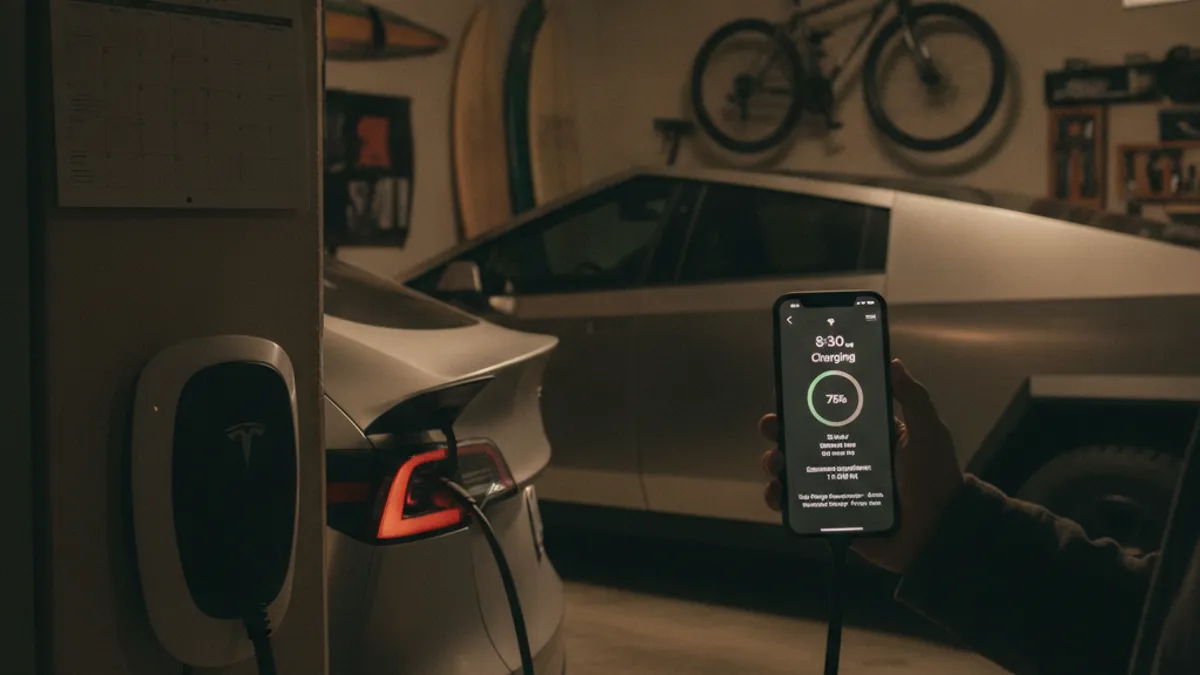
A Supercharger stop and an overnight wall connector are different jobs. So is a 120V outlet in a garage. Drivers mix those clocks and then run short. Valley heat makes the mix worse, because the pack and the cabin both fight the air.
Three clocks, not one charging time
Drivers ask how long does it take to charge a Tesla as if one clock exists. You are filling overnight, topping off on DC, or buying range on a shoulder.
Roadside Level 2 when you are already stuck
Independent operators we connect you with bring a 240V Level 2 source to the bumper. Tesla gets a native NACS plug, not a guess at the port. Typical add is 10 to 20 miles in 15 to 30 minutes of charging. That is enough to reach a Supercharger, or to get home if you are close. It is not a full pack, and it is not a tow.
Heat still eats part of that window. The car may spend early minutes cooling the cabin and the pack. You see fewer miles than the same session on a mild night. For what that truck actually does, read EV charging levels that actually help when you’re already stranded.
Overnight Level 2 at home
A 240V home connector is built for sleep, not a lunch break. Most Model 3 and Model Y packs take about 6 to 10 hours from near empty. NV Energy’s Residential Electric Vehicle Recharge Rider sets an overnight window from 10:01pm to 8:00am. That window is about the same length as a Level 2 fill.
If the car sat in a hot garage all day, the first hour can look slower. Thermal management runs before the pack takes a hard charge. When 240-volt charging at home isn’t an option is the other side of that choice.
DC fast charging on a Supercharger
From around 10% to about 80% often takes 25 to 35 minutes on a newer stall. Older Model S and Model X cars, and older stalls, run slower. Past 80%, the curve drops hard, so most trip planning stops there. The same stall in July is not the same stall in January. The pack protects itself in heat, and charge rate can step down while cooling catches up.
Why 100-degree air slows the session
NWS Las Vegas records an average July high of 104.5F. The valley sees about 78 days at or above 100F. About 9.4 days hit 110F or more. The official all-time record is 120F, set on July 7, 2024.
The airport runs 5 to 15F warmer than outlying areas. East-valley and downtown pavement can run up to 11F hotter than the rim. A Tesla that sat in a Paradise resort lot starts hotter. One that sat in Summerlin shade starts cooler. Summerlin sits near 3,500 feet, while the valley floor sits around 2,000 to 2,920 feet.
Recurrent Auto measured about 5% range loss at 90F. The same work found 17 to 18% loss at 100F. Cooling a hot cabin drew 3 to 5 kW. Holding the cabin took about 1 kW. AAA, in May 2026, measured 8.5% range loss at 95F. None of those figures come from Tesla. Tesla has not published a range-loss number we could cite.
Those studies are about miles you keep, not minutes on a plug. They still explain the roadside clock. If the cabin is a furnace, early charge current goes to cooling. Miles appear later than the dash implied when you parked.
The last 20% is a different wait
Lithium-ion cells take charge fastest in the middle of the pack. They slow as they near full, on purpose. Ten percent to 80% can fit a short stop. Eighty to 100% on the same DC stall can take almost as long again.
Roadside Level 2 almost never chases 100%. The job is 10 to 20 miles, then you move. Home overnight can finish the pack because you are asleep. Mixing those goals is how people overstay a public stall, or leave a shoulder too soon.
Home fill, public fill, and a shoulder fill are not interchangeable
A wall outlet at 120V adds about 3 to 5 miles per hour. A near-empty Model 3 or Model Y can sit two to three days on that circuit. Fine for a car that barely moves. Useless when you are already on I-15 or US-95 with a low pack.
Public Level 2 at a mall or office sits in the 20 to 44 miles-per-hour band. That depends on the car’s onboard charger and the circuit. That is a parked-for-hours tool, not a rescue. When the pack is empty, you need range at the bumper. That is mobile EV charging, not a home connector you cannot reach.
What valley heat does to the miles you just added
A charge that looked like 18 miles on a cool morning can shrink on a 104-degree afternoon. Cabin cooldown, grade, and headwind all spend it. The I-15 south run toward Jean and Primm is a climb in heat. Kyle Canyon Road spends range on elevation. Red Rock’s 13-mile scenic loop is a slow, hot sit with A/C on. None of that is a gap in chargers. It is more work for the same pack on the same afternoon.
If you want the other half of this question, how long a Tesla charge lasts in valley heat is the range side.
If you cannot wait for a stall
NDOT’s Freeway Service Patrol covers the busy valley freeways from 5:00am to 8:30pm. It advertises tire changes, jump starts, fuel, and traffic control. Published patrol materials do not mention EV charging. Nevada 511 at nvroads.com is the conditions feed. None of that fills a Tesla pack on a shoulder.
If the car will not wake, the 12V may be the failure, not an empty pack. When the high-voltage pack is the problem, out-of-charge recovery is the path. Operators quote you before they start and bill you directly. Charge Pro LV does not own the truck and does not set the price. For the empty-pack checklist, see what to do if your Tesla hits zero on a Las Vegas Valley road.
Call (702) 935-4699 if you need that match.
Frequently asked questions
How long does roadside Tesla charging take in valley heat?
Operators typically add 10 to 20 miles in 15 to 30 minutes of charging. Hundred-degree air and cabin cooldown can stretch the same session. That clock is charging time, not arrival time.
How long does a Tesla take on a Supercharger?
A newer stall often reaches about 80% from around 10% in 25 to 35 minutes. Past 80% the rate drops, and heat can slow the curve while the pack cools.
Can I fill a Tesla from a regular wall outlet?
A 120V outlet adds about 3 to 5 miles per hour, so yes, slowly. A near-empty pack can take two to three days.