You walked out to your Tesla last night and the screen took a beat longer than usual. The handles presented on the second try. You drove home and forgot about it. That is a Tesla 12V warning sign. In valley heat, those signs come after days in a hot garage, not after an empty pack.
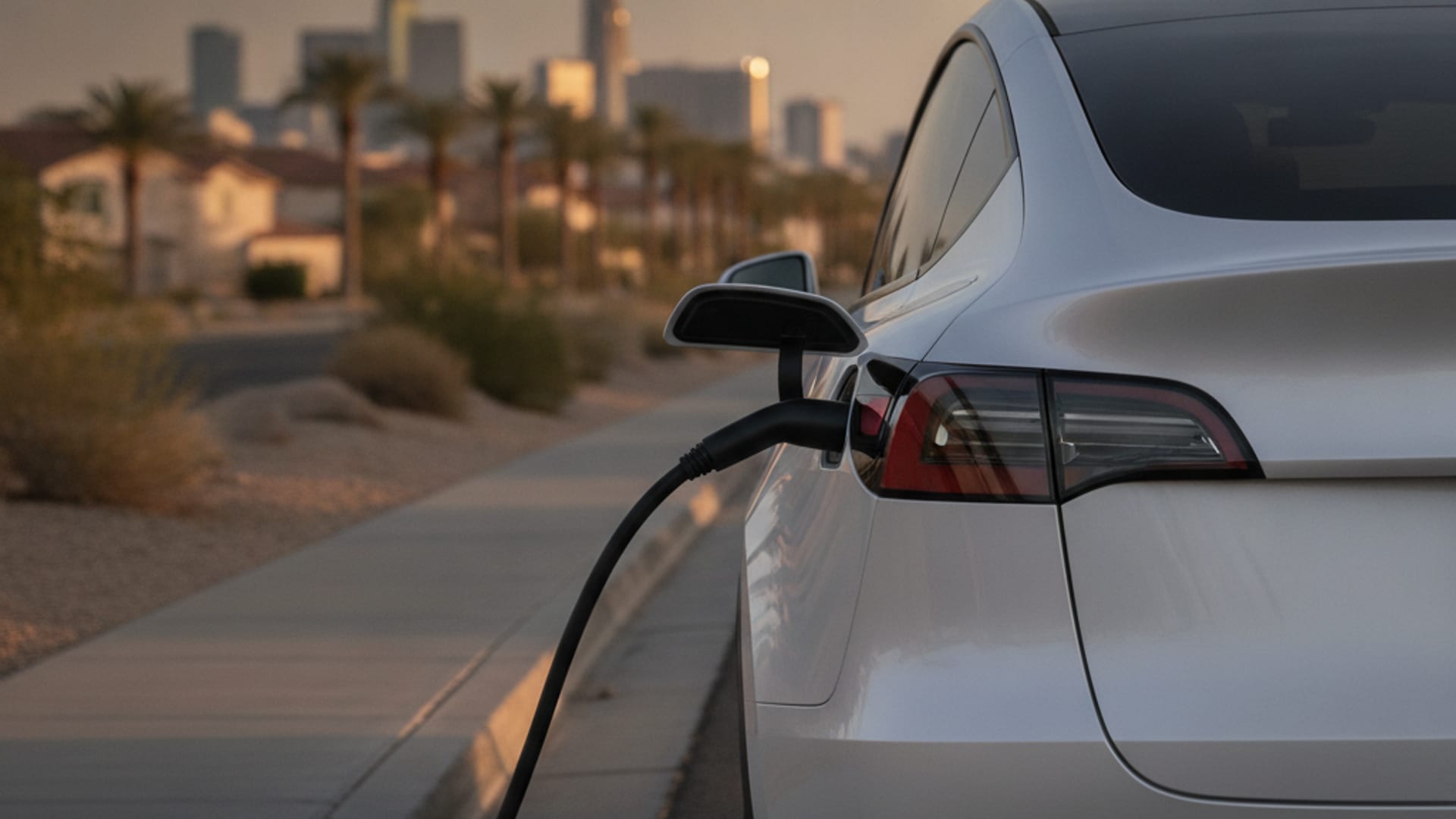
What a wearing 12V feels like before it fails
A healthy Tesla 12V wakes the car in under a second. The handles present on approach. The screen lights immediately. The app connects without a retry. None of those steps ask the 12V to do something the car has not done a hundred times before.
A wearing 12V shows small changes. The handles present after a second pass. The screen takes a beat to light. The app needs a retry to connect. The car beeps on lock instead of clicking quietly. None of those changes look like a failure. All of them mean the 12V is closer to its limit.
Tesla publishes an in-vehicle alert called “12V battery low” or “12V battery needs service.” That alert is the clearest signal. If the car pushed that alert to the screen or the app, treat it as a live fault. The 12V is no longer healthy. Plan a replacement before the next long park.
Why the warnings come after heat, not after miles
NWS Las Vegas averages a July high of 104.5F at KLAS. About 78 days a year reach 100F. About 9.4 days reach 110F. The all-time record is 120F, set on July 7, 2024. A Tesla parked at a Strip resort garage or a Harry Reid lot sits in that heat through the day.
Lead-acid 12V cells lose capacity in heat faster than they lose it in cold. Heat accelerates grid corrosion and water loss. A 12V that would last six years in a cooler climate can fail in three here. Tesla moved many Model 3 and Model Y cars to a lithium 12V around 2021. Both chemistries still age in heat.
The cabin adds another load. Cabin Overheat Protection runs the climate system periodically. Sentry Mode runs the cameras and the network stack. The 12V pays for all of that in the heat. Tesla does not publish a published drain figure for either, so we do not quote one. The behavior is well documented in owner forums.
Recurrent Auto found about 5 percent range loss at 90F and 17 to 18 percent at 100F. Cabin cooling drew 3 to 5 kW to cool a hot cabin. Holding a cool cabin used about 1 kW. AAA, in May 2026, measured 8.5 percent range loss at 95F. Those numbers are about the drive pack, not the 12V. They still explain why the cabin runs hard at a resort garage.
The four warning signs to actually watch
The first sign is a slow screen. If the central display takes more than a second to light, the 12V is asking for help. A healthy 12V lights the screen immediately. A slow screen on a hot day is the most common warning we hear about.
The second sign is a hesitation in the handles. If the handles do not present on the first approach, the body controller is asking the 12V for more current than the 12V can give. The handles are simple motors. They run on 12-volt power. A hesitation means the small battery is close to its limit.
The third sign is an app that needs a retry. If the Tesla app does not connect on the first try, the cellular modem and the network stack are not getting the 12V they expect. A retry works because the 12V recovered slightly during the wait. That recovery is not a fix.
The fourth sign is the in-vehicle alert. “12V battery low” is Tesla’s own phrasing. If you see it, do not plan a Red Rock Canyon scenic loop on the car. Do not plan a Jean run. Plan a replacement.
Do Teslas have a 12V battery is the short answer for any reader who has not met the small battery yet. The warning signs above apply to every Tesla on the road.
What to do when you see the first sign
Stop adding parked load. Turn off Cabin Overheat Protection. Turn off Sentry Mode. Both settings draw the 12V faster than a typical overnight sit. The 12V still has a small parked load, but a smaller one.
Drive the car more, not less. The DC-DC converter charges the 12V from the drive pack while the car is awake. A 20-minute drive at highway speeds does more for the 12V than a week of plugged-in rest. The 12V does not recover from a long sit by being plugged in. It recovers from use.
Schedule a 12V replacement. A 12V that has shown one warning sign will show the next. The next sign may be the last one you see before the car goes dark. Charge Pro LV is a referral line for that replacement. The operator brings the part and quotes the work before they start.
For the broader picture, EV 12V battery replacement signs lists the warnings that show up before a full failure. Tesla 12V battery jump is the service page that explains the same procedure for any modern EV.
When the warning signs turn into a stall
A car that went dark after a long sit is showing the failure mode, not the warning mode. The handles do not present. The screen is off. The app does not connect. The 12V is below its working voltage.
Use the documented 12V jump points. On a Model 3 or Model Y, the jump points sit under the hood, front right. On a Model S or Model X, the jump points sit in the frunk area near the firewall. Do not use the charge port.
A jump that wakes the car is a test, not a repair. If the car wakes and the drive pack still shows charge, the small battery failed. Plan a replacement. Charge Pro LV connects you with an operator who can do that on site. The operator quotes you before they start and bills you directly.
For the broader pattern, Tesla 12V battery failure in valley heat walks the same desert climate and the same failure mode. The warning signs above are the early chapter of that page.
What a healthy 12V buys you in valley heat
A healthy 12V lets the car survive a long park at a Strip self-park, a Harry Reid lot, or a Henderson apartment complex. It wakes the car on the first approach. It runs the network stack. It closes the contactors when you press the brake.
A wearing 12V survives one of those. It does not survive two. The desert climate is the accelerant. The fix is not a software update. The fix is a replacement 12V.
For more on the climate, the NWS Las Vegas climate page and the Recurrent Auto heat-loss data are the open sources.
When the warning signs turn into a stall, call (702) 935-4699. Charge Pro LV connects you with a local operator. For the broader valley map, start at EV charging in the Las Vegas Valley.
Frequently asked questions
What are the warning signs that a Tesla 12V is failing?
Slow screen, hesitant handles, an app that needs a retry, and the in-vehicle “12V battery low” alert. All four show up after days in a hot garage, not after an empty drive pack.
Why do Tesla 12V warnings come after heat, not after miles?
Heat accelerates 12V wear. NWS Las Vegas counts about 78 days at or above 100F. A 12V that would last six years in a cooler climate can fail in three here. The warnings are climate-driven, not mileage-driven.
What should I do when I see the first warning sign?
Turn off Cabin Overheat Protection and Sentry Mode. Drive the car for 20 minutes at highway speeds. Schedule a 12V replacement. Do not plan a long park or a long trip on the car until the 12V is replaced.
How do I tell a 12V warning from an empty drive pack?
A 12V warning shows up after a hot sit, before the car moves. An empty drive pack shows up after the car has been driven. The first is a parked-load failure. The second is a use failure. They look different on the dash.