A Ford Mustang Mach-E that sat through a valley afternoon often won’t start. The traction pack can still hold a healthy charge. The usual no-start here is a dead 12V after a hot park. It isn’t a traction-pack failure.
Valley heat hits the 12V first
Parked Mach-E calls in this climate cluster after a long hot sit. Paradise resort lots and Winchester side streets bake harder than the west rim. The east valley and downtown can run up to 11F hotter than Summerlin. Summerlin sits near 3,500 feet. The valley floor sits closer to 2,000 to 2,920 feet. Henderson sits lower still, around 1,867 feet.
The National Weather Service in Las Vegas clocks an average July high of 104.5F. About 78 days a year hit 100F or more. About 9.4 days reach 110F. The all-time record is 120F, set on July 7, 2024. Harry Reid International Airport sits in unincorporated Paradise, not the City of Las Vegas. It often runs 5 to 15F warmer than outlying areas. A Mach-E in Long Term or Economy parking soaks that extra heat all afternoon.
A 12V lead-acid battery takes a beating in that soak. Cabin electronics still sip power while the car sleeps. A door that isn’t fully latched keeps modules awake. Short Strip hops don’t let the DC-DC converter refill the 12V.
Recurrent Auto measured about 5% range loss at 90F. It found 17 to 18% at 100F. AAA’s May 2026 test found 8.5% range loss at 95F. Air conditioning can draw 3 to 5 kW to cool a hot cabin. Those figures describe miles in the pack. They don’t tell you whether the Mach-E will wake. The car can keep plenty of range and still sit dark. The 12V gave out first.
Two failures, two different looks
The Mach-E carries a high-voltage traction pack that moves the car. It also carries a small 12V auxiliary battery. That’s the same job a starter battery does in a gas Mustang. The 12V feeds computers, screens, locks, lamps, and the pack contactors.
Until the 12V comes up, the Mach-E can’t close those contactors. It can’t tap the traction pack at all. You keep a charged pack and a car that acts like it’s been unplugged. That’s the mix-up most owners hit after a hot sit. They check last night’s range reading and assume the pack died. The pack is fine, and the wake-up battery isn’t.
A dark Mach-E with a healthy pack usually fails in these ways. Keys and the phone app get silence, and doors stay locked. The center screen never stays on. It may flash, then go black. Interior lamps look weak, relays click, and you hear no chime. Plug-in charging never begins. The car never boots far enough to start a session.
An empty traction pack looks different. You get a low-range warning, limp power, or a blocked shift into Drive. The car is awake, and it just has nowhere to go. Read what happens when an EV’s 12-volt battery dies in the valley.
If the car is awake with an empty pack, a 12V jump won’t add miles. You need range delivered at the bumper. Ford’s Lightning hits the same 12V heat stall. The same stall shows up on the Ford F-150 Lightning won’t start guide.
What Ford’s messages actually mean
Ford’s alerts are blunt, not a full diagnosis.
“System Off to Save Battery,” or a shutdown countdown, often tracks a weak 12V. The car is rationing the remaining power.
“Key Fob Not Detected” can be the fob coin cell. It can also be a 12V too low to run the receivers. Replace the fob battery if you can. Then treat the car’s 12V as the next suspect.
A blank screen with no power is the classic 12V fail. The car can’t even draw a warning.
“Stop Safely Now” is a harder message. It can point at the high-voltage side or another critical fault. Get out of the traveled lane if you can, then get help.
“Service Vehicle Soon” and generic lamps need a shop later. They don’t always block a start.
Match the words to what the car will still do. Black and silent still means 12V until you prove otherwise.
Find the 12V in the frunk, then stop guessing
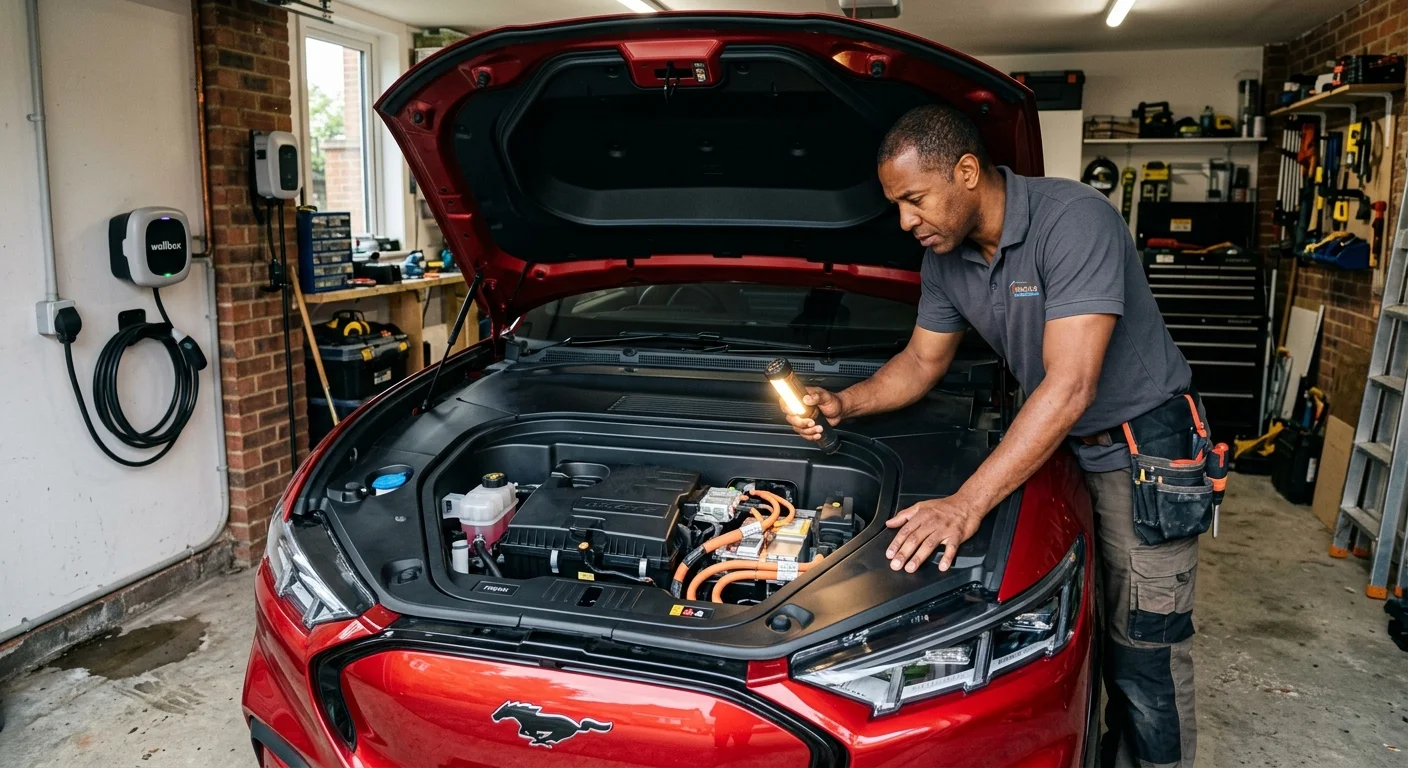
Ford put the Mach-E’s 12V under the hood. It sits on the passenger side of the front trunk. It isn’t in the rear cargo area.
Open the frunk with the fob or the interior release if those still work. Find the plastic cover on the passenger side. Lift it and you’ll see a conventional 12V battery.
Jump posts are usually easier than the battery clamps. Ford places a positive post under a red cap in the frunk. A nearby bare metal bolt or bracket is the ground. Use the points your manual shows. Don’t clip onto random painted metal.
If the frunk latch has no power, stop. Don’t pry the lid. Wait for an operator who can reach the 12V without guessing. See how to jump start an EV in desert heat for cable order.
You’re only feeding the 12V system, not the high-voltage pack. Stay on the marked 12V terminals, and leave the orange high-voltage cables alone.
Follow Ford’s cable order for your year. Keep the Mach-E powered once it wakes. Drive it or plug it in so the DC-DC converter can refill the 12V. If it won’t hold, replace it. If it dies again, see signs your EV 12V needs a replacement.
When the pack is actually empty
Sometimes the Mach-E really did spend the traction pack down to zero. A jump then does nothing useful. There’s no energy left to move the car, even with a healthy 12V.
Independent operators we connect you with bring 240V Level 2 to the bumper. Your Mach-E isn’t a Tesla. Tell the operator the year and the port you have. Ask for non-Tesla EV rescue. The pros we send bring a CCS or J1772 adapter for non-Tesla EVs. A typical session adds 10 to 20 miles. That takes 15 to 30 minutes of charging. That’s charge time at the car. It isn’t a promise of when someone arrives.
Charge Pro LV doesn’t install home chargers. Clark County’s Title 30 code requires EV-ready wiring in new construction. A Level 2 home charger needs an electrical permit. Roadside help is the 12V, plus a jump or a replacement on site.
A stuck port is a different problem. See Ford Mustang Mach-E charge port stuck.
Where a dark Mach-E usually sits in the valley
A crossover that baked in a Paradise resort garage sits in the heat island. The Strip and the airport sit in unincorporated Clark County. That’s Paradise and Winchester, not the City of Las Vegas. Help on that corridor is in EV roadside assistance in the Strip. The same heat sits on an Allegiant Stadium event lot. That follows a Raiders or UNLV crowd. Town Square stalls on the south Strip hold it too. A lot in Enterprise off the I-15 south launch gets the same bake. A Henderson lot can still hold afternoon heat while the rim cools.
Nevada has no toll roads, express lanes, or transponder systems. I-15, I-215, CC-215, US-93, US-95, and I-11 are all free.
If the Mach-E dies on a freeway shoulder, NRS 484B.440 covers a disabled stop. It applies when the driver can’t avoid staying put. The statute doesn’t set a time cap on that stop. After 24 hours on a freeway, NRS 484B.443 applies. Law enforcement can treat the car as abandoned. The owner pays removal. Get it moving before that clock matters.
NDOT’s Freeway Service Patrol covers the busiest valley freeways. Hours are 5:00 a.m. to 8:30 p.m. Quality Towing operates it, and GEICO sponsors it. The patrol advertises tire changes, jump starts, fuel, minor fire suppression, and traffic control. None of NDOT’s published patrol materials mention electric vehicles or EV charging. A gas-style 12V jump may still be in their toolkit. They don’t advertise a charge for an empty pack. Nevada 511 at nvroads.com is the conditions board.
Inside Harry Reid parking, call the airport’s own line at (702) 261-5122. It offers free battery jump starts and tire inflation. Whether those lots have EV charging isn’t published on the airport site. Dark in Long Term or Economy still starts as a 12V-or-pack question.
What a Charge Pro LV call actually does
Charge Pro LV is a referral line for the Las Vegas Valley. It matches you with an independent mobile rescue operator. The brand doesn’t own trucks, employ technicians, or set a price. The operator quotes you before any work starts, then bills you directly. The pros we connect you with are licensed and insured.
On a 12V call, the operator tests that small battery first. If it’s only discharged, they jump the Ford terminals. Then they let the car’s DC-DC converter refill it from the traction pack. If the 12V won’t hold, they can replace it on site. On an empty-pack call, they plug in Level 2. That adds 10 to 20 miles so you can roll to a charger.
Ask what the quote includes. Distance, how much range you need, and time of day all change the number. Charge Pro LV doesn’t publish rates. Confirm the figure with the operator before they start.
If your Mach-E won’t start, call (702) 935-4699. Describe whether the screens are black or the car is awake with no range. That split tells the operator which kit to bring.