When a GMC Hummer EV won’t start after a hot sit, start with the 12V. The Ultium pack is probably still fine. The 12V boots the computers and closes the contactors. When it’s flat, the truck goes fully dark. You get no dash, no handles, and no Watts to Freedom screen. A jump or a 12V swap at the truck is the usual fix. A shop tow is the long way around. You can often wake this battery in the lot.
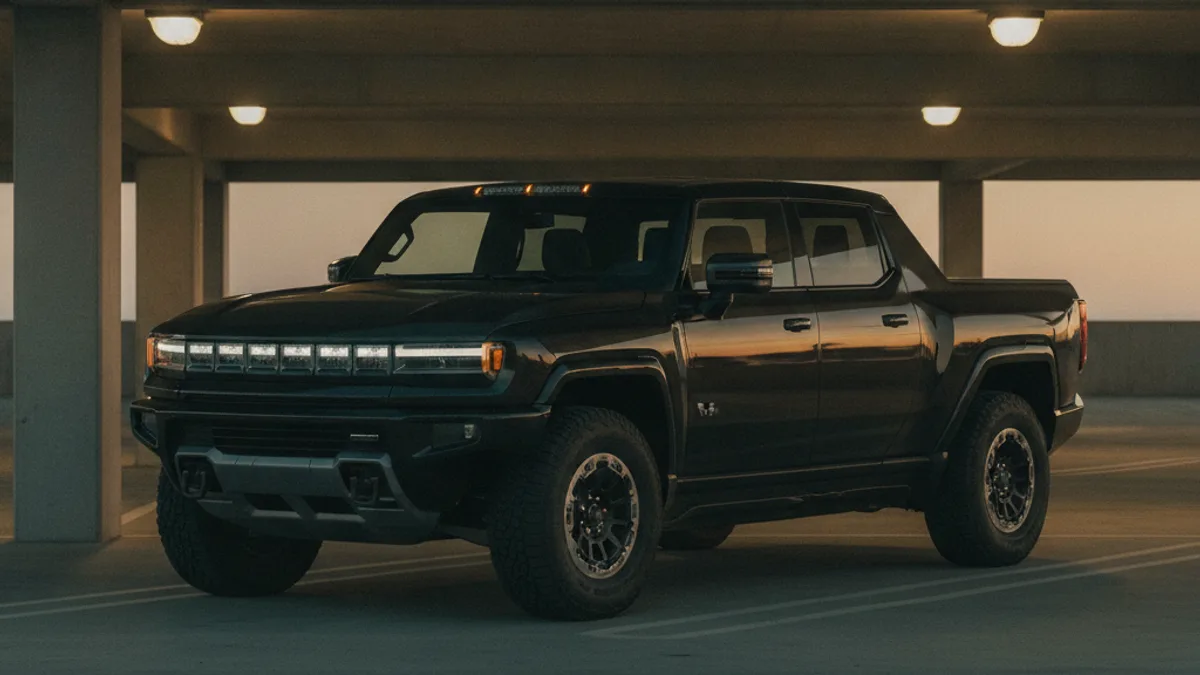
A dead 12V looks like a dead truck
The range readout tracks the Ultium pack, not the 12V. You can have plenty of range and still get nothing. The handshake never finishes. Cabin electronics stay dark. Power doors ignore the fob. The eTrunk button does nothing. Treat that pattern as a 12V fault until you prove it isn’t.
An empty drive pack looks different. Screens still load. Warnings still stack. The truck still talks. A Hummer with a dead 12V doesn’t talk. It just sits there. That’s why a dealer tow is the wrong first move after a hot afternoon in Paradise. The truck didn’t dump its drive battery on the walk back from the casino. It lost the small battery that wakes everything else.
The 12V feeds modules, latches, and contactor coils. Heat makes those modules work harder. Alarms, telematics, and cabin preconditioning keep sipping current while you shop. A few hours on blacktop can sag a weak 12V. A week in a closed garage can drain a healthy one. Either way you get the same dark cabin.
Why valley heat is so hard on this battery
NWS Las Vegas puts the average July high at 104.5F. About 78 days a year reach 100F or more. About 9.4 days reach 110F. The all-time record is 120F, set on July 7, 2024. That’s official air temperature. Asphalt and a closed cabin run hotter.
The airport heat island runs 5 to 15F warmer than outlying areas. Downtown and the east valley can run up to 11F hotter than the rim. A Hummer in Winchester or Sunrise Manor is cooking harder than one in Summerlin. Summerlin sits around 3,500 feet and climbs toward 4,400 near Red Rock. The valley floor sits about 2,000 to 2,920 feet. Elevation doesn’t save a black pickup on a sunny deck. It just means the west rim is milder than Fremont Street. A still Paradise garage stays brutal.
Recurrent Auto found about 5 percent range loss at 90F and 17 to 18 percent at 100F. AAA, in May 2026, measured 8.5 percent range loss at 95F. Those figures describe the drive pack, not the 12V. They still show the heat a parked Hummer is sitting in.
The pattern is simple even without a GMC wear curve. Heat plus a long sit. Then a truck that won’t wake.
Where this shows up around the valley
The first setting is paved and still. A Hummer sits in a Paradise resort garage while you stay on the Strip. The Strip is unincorporated Clark County. It isn’t the City of Las Vegas. Harry Reid International Airport sits in Paradise too. Long-term parking there is a classic 12V drain. The airport offers free battery jump starts and tire inflation at (702) 261-5122. That line is a conventional 12V jump, not an EV charging desk. The airport site doesn’t publish whether those lots have EV chargers. Confirm a plug in person before you count on one.
Event parking does the same drain. Allegiant Stadium in Paradise fills for Raiders and UNLV games. Sphere and the Las Vegas Convention Center leave cars in hot structures for hours. You return and the Hummer is a brick. The pack didn’t dump most of its charge during the show. The 12V quit on the wake-up sequence.
The second setting is the one this truck was built for. Owners take Hummer EVs to Red Rock Canyon National Conservation Area. The 13-mile scenic loop is BLM land. Timed-entry reservations run October 1 to May 31. Lights, lockers, and accessories run all day. A 12V that was already weak can be empty at the pullout. Lake Mead National Recreation Area is the same kind of day. You leave Henderson with range on the gauge. You come back to a truck that won’t unlock.
If you stall on I-15, I-215, CC-215, US-93, US-95, or I-11, you’re on a free road. Nevada has no tolls. NDOT’s Freeway Service Patrol covers the busiest valley freeways from 5:00am to 8:30pm, seven days a week. Quality Towing operates it under a GEICO sponsorship. They advertise jump starts, tire changes, fuel, minor fire suppression, and traffic control. Their published materials don’t mention electric vehicles or EV charging. Ask whether they can jump a 12V when they stop. Nevada 511 and nvroads.com show closures and cameras if you need a status check.
Don’t slam a door on a dead Hummer
Power doors on this truck drop the glass a fraction when you open them. They raise it as the door shuts. That indexing keeps the window off the roof seal. It needs 12V. With the battery dead, the glass stays put. Close a door with normal swing and the glass can hit the sky panel. It can also hit the A-pillar trim. The glass can chip or crack.
Treat every door as a manual panel until the 12V is alive. Ease it shut. Don’t let the last few inches slam. In a Town Square lot or a garage off Fremont, that slam is the expensive habit. The 12V is the small problem. A cracked pane isn’t.
The shift warning that isn’t a transmission fault
Owners often see “conditions unable to shift” before a full no-start. Other electrical warnings pile on. GMC’s spec puts a resting 12V at 12.4 to 12.8 volts. A running system sits at 14.4 to 14.8 volts. Below that resting window, modules disagree. Shift logic fails. Screens stall. The truck may refuse to wake at all.
Cycling power doesn’t restore voltage. Reloading the infotainment doesn’t either. Jump or charge the 12V back into range. The stacked errors usually clear once the modules have stable power. If they don’t, you’re past a simple drain. Then you’re looking at a replacement.
How to reach the 12V when the eTrunk is locked
GMC put the 12V in the eTrunk, on the passenger side. It sits under a plastic cover held by three tabs. That’s simple when the button works. The release is electric. A dead 12V also locks the frunk.
There’s a mechanical pull for this. Sit in the driver’s footwell. Look left of the brake pedal, up behind the wiring harness. You’ll find a silver wire with a loop. Pull that loop until it gives. The eTrunk should pop with no electrical power. It’s tucked, so the first try takes patience. Don’t yank random harnesses. The loop is the designed backup.
Once the lid is up, lift the cover by those three tabs. The battery and jump terminals are under it. The positive post sits behind a red sliding door. Flip the door and clamp there. The negative terminal is to the left, beside a green connector. Clamp positive first. Then clamp negative to that ground terminal. Wait a minute before you ask the truck to boot.
A standard jump pack wakes most Hummers that sat through an afternoon. A pack that’s been down for days may not. An AGM-rated charger on those terminals for about an hour can raise voltage. That’s often enough to try a start. For clamp order and the safety notes, use our guide to jump starting an EV in desert heat. Don’t reverse the clamps. Don’t try to jump from another EV’s charge port. This is a 12V job on the eTrunk posts.
When a jump isn’t the real fix
If the truck wakes, don’t assume you’re finished. Drive it long enough for the DC-DC converter to refill the 12V. If it dies again the next morning, the battery isn’t holding. Repeated no-starts after a jump mean replacement, not another jump. Our signs your EV 12V needs a replacement walks through that pattern. What happens when an EV 12V dies in the valley covers the same stall. One small battery can shut down a truck with a huge Ultium pack.
Here’s the short map:
- Dark dash and dead handles: the 12V is fully discharged.
- Shift warning and electrical nags: resting voltage is below 12.4 to 12.8V.
- eTrunk button dead: not enough 12V for the release.
- Window hits trim on a close: indexing is offline.
- Another no-start a day later: the 12V needs replacement.
Jump, replace, or tow
A shop tow makes sense when a new 12V still won’t boot the truck. It also makes sense after a crash or a pack fault. For a Hummer that sat in 100-degree parking and went dark, start at the bumper. Jump it. See if it holds. Swap the 12V in the lot if it won’t. Then drive to a dealer on the truck’s own wheels.
If the Ultium pack is actually empty, that’s a different call. A mobile operator can bring a 240V Level 2 source to the car. A CCS or J1772 adapter covers a Hummer. That typically adds 10 to 20 miles of range in 15 to 30 minutes of charging. That’s charging time, not an arrival time. Wake the 12V before anyone plugs the port.
The GM family shares this low-voltage behavior. If you also drive the electric Sierra, see the GMC Sierra EV emergency charging guide. It covers the same platform when the pack, not the 12V, is the problem.
Under NRS 484B.440, a disabled vehicle that can’t avoid stopping is exempt from the no-stopping-on-highway rule. The statute sets no time limit. Under NRS 484B.443, officers may still remove a disabled or abandoned vehicle. On freeways that’s 24 hours. On other roads it’s 72 hours. The owner pays removal. Stay with the Hummer and use hazards.
What Charge Pro LV actually does
Charge Pro LV is a referral line for the Las Vegas Valley. We don’t own rescue trucks or employ technicians. We don’t set prices or publish hours. We connect you with independent local operators. The operator quotes you before work starts and bills you directly.
On a non-Tesla EV rescue call, the pro we send brings 12V jump gear for a large GM truck. They can use the manual eTrunk release if the button is dead. They can jump the 12V and tell you if it needs a swap on site. If the pack is the real problem, they can add roadside range instead. See EV rescue versus repair in the Las Vegas Valley if you’re unsure which job you have.
If the Hummer is dark and the eTrunk won’t open, don’t force the doors shut. Call (702) 935-4699. We’ll match you with an operator who can quote the 12V work at the truck.
Frequently asked questions
Why won’t my GMC Hummer EV start when the range gauge still looks fine?
The gauge reads the Ultium pack. Startup runs on the 12V. If that battery is dead, the truck can’t boot. A 12V jump is the usual way back.
Where is the 12V in a GMC Hummer EV, and how do I reach it with no power?
It’s in the eTrunk on the passenger side, under a three-tab cover. If the button is dead, pull the silver loop in the driver’s footwell, left of the brake. That mechanical release opens the eTrunk with no power.
Can I close the doors while the 12V is dead?
Close them slowly, by hand, without a slam. Window indexing is offline without 12V. A normal close can chip the glass. Jump the battery first when you can.