A Ford F-150 Lightning doesn’t have one charging clock. Ford lists about 41 minutes from 15 to 80 percent on DC fast. That’s the Extended Range pack in mild conditions. Home Level 2 on that pack is about 8 to 10 hours. In Las Vegas Valley heat, both clocks run long. A roadside Level 2 session isn’t a full fill. The pros we connect you with typically add 10 to 20 miles. That takes 15 to 30 minutes of charging. That’s charging time at the truck, never an arrival clock.
Two packs, two home clocks
Ford sells the Lightning as Standard Range or Extended Range. Those packs don’t fill on the same schedule. Standard Range holds about 98 kWh total, with about 89.5 kWh usable. Extended Range is about 131 kWh total, with about 120 kWh usable. The bigger pack takes more hours on a wall unit. On a DC fast stall, it also accepts a higher peak rate. That’s why a 15 to 80 percent stop lands close on both trucks.
How long it takes to charge a Ford Lightning depends on the pack you bought. The plug, starting percent, and pack temperature all change the clock. A generic number won’t plan a valley workday.
Heat is what moves the real number
Ford’s listed times assume a cool pack and a stall at full output. NWS Las Vegas puts the average July high at 104.5F. About 78 days a year hit 100F or more. About 9.4 days reach 110F. The all-time record is 120F, set on July 7, 2024.
Harry Reid International Airport runs 5 to 15F warmer than outlying areas. The east valley and downtown can run up to 11F hotter than the rim. A Lightning sitting in Sunrise Manor or Winchester soaks more heat than one in Summerlin. Summerlin sits near 3,500 feet and climbs toward 4,400 feet near Red Rock. The valley floor sits about 2,000 to 2,920 feet. Henderson sits lower, around 1,867 feet.
Recurrent Auto found about 5% range loss at 90F. Loss rose to 17 to 18% at 100F. Cabin air conditioning drew 3 to 5 kW to cool a hot cabin. Holding temperature drew about 1 kW. AAA’s May 2026 test measured 8.5% range loss at 95F. Those aren’t Ford figures. They still describe what a truck this size spends before you plug in.
A hot pack protects itself. It accepts fewer kilowatts until the cooling loop catches up. Public cabinets often derate in the same weather. You sit longer than Ford’s 41-minute window.
Overnight Level 2 across valley utilities
A 120-volt outlet still works, but treat Level 1 as a spare. A full fill from empty can take several days on a pack this size. Ford’s Charge Station Pro can deliver up to 80 amps on a dedicated circuit. In mild weather, Extended Range fills in about 8 to 10 hours. Standard Range is about 6 to 8 hours. A 48-amp wall unit stretches a full charge toward 12 to 14 hours. Valley heat doesn’t rewrite those circuits. It can slow the start if the pack is still hot when you park.
NV Energy serves Las Vegas, North Las Vegas, Henderson, and Paradise. It also covers Winchester, Spring Valley, Enterprise, Sunrise Manor, Summerlin, and Whitney. Boulder City runs Boulder City Utilities, not NV Energy. Blue Diamond, Indian Springs, and Sandy Valley sit on Valley Electric Association. Moapa Valley, Logandale, and Moapa sit on Overton Power District No. 5. Don’t call NV Energy from those addresses.
NV Energy names a Residential Electric Vehicle Recharge Rider, with a charging window from 10:01pm to 8:00am. It also names Residential EV Charging Station Incentives. This page doesn’t publish rebate dollars. Confirm every amount on nvenergy.com before you buy a wall unit. Nevada has no state EV purchase rebate.
Clark County Title 30 requires EV-ready wiring in new construction. A Level 2 home charger still needs an electrical permit. Charge Pro LV doesn’t pull that permit, and we don’t install stations. Compare a home circuit with help at the truck in When 240-volt charging at home isn’t an option. Winchester’s housing is among the oldest in the valley. That’s a panel-age proxy, not a charging map.
A DC fast stop after a 104-degree park
Ford lists about 41 minutes from 15 to 80 percent on Extended Range. That needs a stall that can feed peak power. Standard Range is listed near 44 minutes. Both need a mild pack temperature and a cabinet at rated output.
The Lightning takes power fastest in the middle of the curve, then it tapers. Most drivers stop near 80 percent on a trip. The last 20 percent can eat almost as much clock as the rest. Don’t wait for 100 percent at a public stall if you’re trying to move.
Heat adds a second taper. The pack limits kilowatts to protect the cells. The cabinet may limit them too. A July stop in Paradise starts from a soaked pack. That’s true near Allegiant Stadium and Harry Reid. A morning stop on the Summerlin rim starts cooler.
Tesla owners see the same heat stretch. How long does it take to charge a Tesla in valley heat walks that curve.
Grades spend the miles you thought you had
The brochure assumes a flat day, and valley routes aren’t flat. I-15 south climbs through Jean, about 2,841 feet, toward Primm at about 2,618 feet. Railroad Pass sits near 2,360 feet on the Boulder City run. Kyle Canyon Road climbs toward Mount Charleston, where the town sits about 7,506 feet. A Lightning that was fine on the valley floor can still run short. Those grades leave the pack hot and low.
US-95 toward Indian Springs sits about 3,169 feet. That north run spends range in heat and headwind. Red Rock Canyon’s 13-mile scenic loop is a BLM timed-entry road from October 1 to May 31.
There’s no toll on I-15, I-215, US-95, or I-11. You still pay in kilowatt-hours. If the pack is empty on that south climb, read Out of charge on I-15 south toward Primm.
NDOT’s Freeway Service Patrol covers the busiest valley freeways from 5:00am to 8:30pm, free to motorists. Published materials don’t advertise EV charging. NRS 484B.440 lets a disabled vehicle stay on the highway when it can’t avoid stopping. Stay visible and get off the travel lane if you can.
When the session never starts
A slow charge and a dead charge are different jobs. If the Lightning won’t wake, check the 12-volt first. The small battery runs the screens, latches, and the contactor that connects the traction pack. Heat shortens 12-volt life in the desert. A full traction pack won’t save you if that small battery is dead.
Start with Ford F-150 Lightning won’t start: dead 12V in desert heat. Pro Power Onboard is a separate question. Can an F-150 Lightning charge another EV on the shoulder covers that path.
Harry Reid’s named lots include Long Term parking. Whether those lots have EV charging isn’t published on the airport’s site. Don’t count on a stall you can’t confirm.
If the Lightning is already stopped
Charge Pro LV is a referral line for the Las Vegas Valley. We match stranded EV drivers with independent local mobile rescue operators. We don’t hold a trade license, own trucks, or employ technicians. The operator quotes you before starting and bills you directly. The pros we connect you with are licensed and insured.
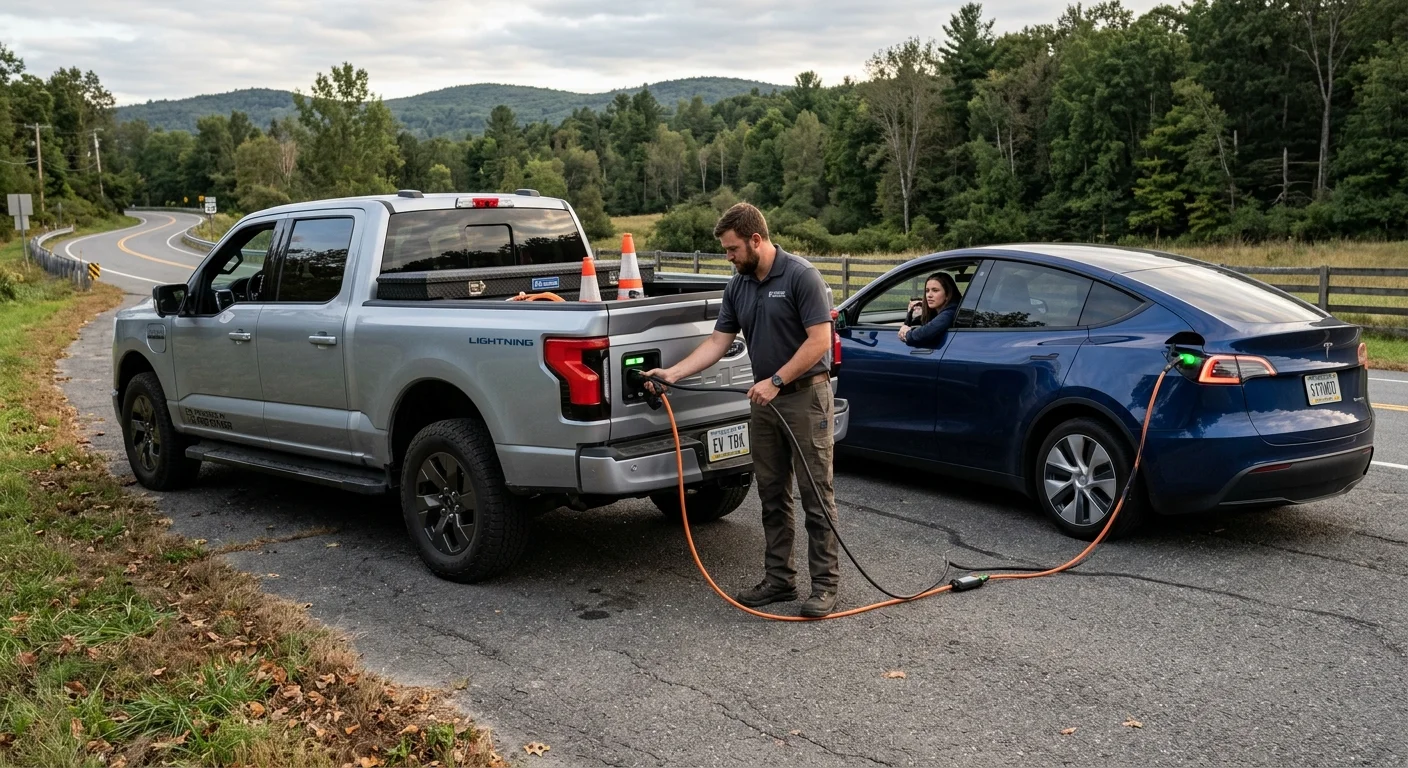
CCS and J1772 Lightnings go through non-Tesla EV rescue. A 240-volt source brought to the truck is mobile EV charging. Operators typically add 10 to 20 miles of range. That takes 15 to 30 minutes of charging. That’s charging time on site, never an arrival clock.
Paradise holds the Strip, the airport, and Allegiant Stadium. It’s unincorporated Clark County, not the City of Las Vegas.
Call (702) 935-4699 when you want a match.
Frequently asked questions
How long does it take to charge a Ford Lightning at home?
A Level 2 unit like Ford’s Charge Station Pro is the usual home setup. Mild-weather fills run about 6 to 8 hours for Standard Range. Extended Range is about 8 to 10 hours. Valley heat can slow the start of that session. A 120-volt outlet can take several days from empty.
Why does a DC fast charge run longer than Ford’s 41 minutes here?
Ford’s 15 to 80 percent times assume a cool pack. They also assume a stall at full rate. That’s about 41 minutes on Extended Range and about 44 minutes on Standard Range. July highs near 104.5F make both derate. The curve also slows as you climb toward full. Most stops target 80 percent for that reason.
What if my Lightning won’t charge at all?
That’s usually the 12-volt, not the traction pack. If the truck won’t wake, jump or replace the small battery on site. If the pack is empty, a local operator can bring Level 2 to the truck.