Tesla doesn’t publish a figure for how long the main pack lasts in this heat. The useful local answer still exists. Geotab found hot-climate batteries degrade about 0.4% per year faster. NWS Las Vegas counts about 78 days at or above 100F. Phoenix-style desert heat is Geotab’s worst case, and the Las Vegas Valley sits in that class.
People mix this up with a Tesla that will not wake. The small 12V battery can leave the car dark even when the pack is full. This piece is about the high-voltage pack under the floor. That’s the one that holds your driving range.
Two batteries, two clocks
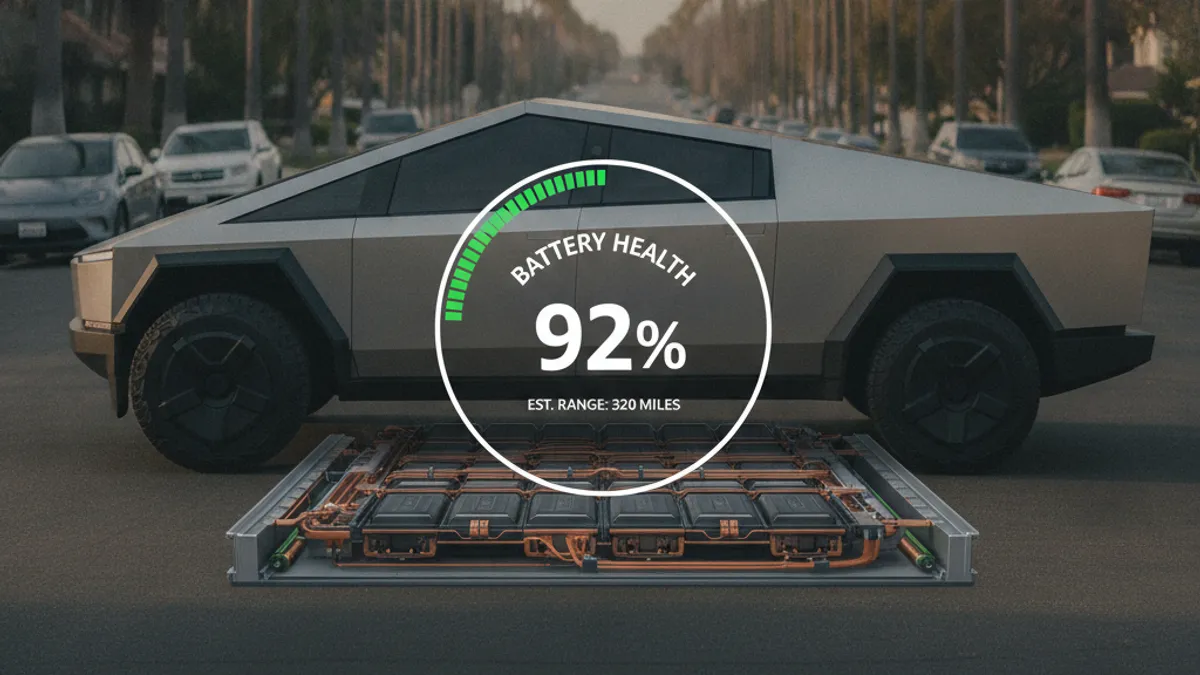
Every Tesla runs two batteries with two jobs. The main pack is thousands of lithium-ion cells under the floor. It stores the energy that actually moves the car. The 12V battery is a small, separate unit. It powers locks, the screen, and the contactors that wake the pack.
The 12V is the one that usually needs service first. Heat shortens that small battery’s working life. It does not measure traction-pack health. If the car stays dark and the app still shows charge, you are looking at the 12V. Tesla looks dead: is it the 12V or the pack? splits those two failures.
Geotab’s extra wear, not a Tesla loss number
No Tesla-published lifespan or loss figure turned up for this climate. Independent fleet data is what we can cite. Geotab found batteries in hot climates degrade about 0.4% per year faster than milder ones. It named Phoenix-style desert heat as the hardest case.
That extra rate is not a warranty term. It is not a remaining-range promise. It is added calendar aging on top of ordinary wear. A pack that lives here pays a desert penalty every summer.
NWS data at KLAS explains why the penalty sticks. The average July high is 104.5F. About 78 days a year reach 100F or more. About 9.4 days reach 110F or more. The record high is 120F, set on July 7, 2024. Chemistry that sits through that calendar is not living a mild year.
The valley is not one temperature
Heat is uneven across Clark County. The valley floor sits about 2,000 to 2,920 feet. Summerlin sits near 3,500 feet and climbs toward 4,400 feet near Red Rock. Henderson sits around 1,867 feet. Downtown and the east valley can run up to 11F hotter than the rim. The airport often runs 5 to 15F warmer than outlying areas.
A Tesla that soaks all afternoon in a Paradise resort lot takes more pavement heat than one in a shaded Summerlin garage. So does a car on a Winchester side street off the Strip. Sunrise Manor and the rest of the east side pick up that urban bump. Elevation, asphalt, and shade change the load on the pack. A cabin that bakes for hours with the car parked adds more.
This is about where cars sit, and how long they sit hot. Harry Reid long-term parking, an Allegiant Stadium lot after a night game, a Red Rock trailhead: the pack is living in stored heat, not in a lab. That is the local wear story.
A hot day’s missing miles are not a dying pack
Heat also cuts the range you see on one drive. That dip is not the same as years of cell wear.
Recurrent Auto found about 5% range loss at 90F, and 17 to 18% at 100F. Air conditioning can draw 3 to 5 kW to cool a hot cabin, versus about 1 kW to hold it. AAA, in May 2026, measured 8.5% range loss at 95F.
None of those numbers come from Tesla. A July range drop that recovers in October is weather. Lasting capacity loss is slower. How long a Tesla charge lasts through a valley heat day is the daily version of this question.
A Lake Mead day trip makes the split obvious. Cabin cooling, grades, and 100F air spend miles that come back when the weather eases. They do not, by themselves, prove the pack is worn out.
Habits that stack more heat on the pack
You cannot move the climate. You can change how you charge and park.
Tesla recommends a daily window around 20% to 80% on most models. Save 100% for a long trip. A pack that sits full in a hot lot is under more cell stress than one held in the middle. A pack that sits near empty for weeks is the other hard case.
Supercharging on a road trip is normal use. Making DC fast charging your only method, day after day, adds more heat cycling than a slow home charge. NV Energy customers can use the Residential Electric Vehicle Recharge Rider overnight window, 10:01pm to 8:00am. That cooler, slower session is easier on cells than a midday Supercharger stop on an already hot pack.
Boulder City is not on NV Energy. Its municipal utility is separate, so that overnight rider does not apply there. Valley Electric Association serves Blue Diamond and similar rim communities. Confirm the rate with your own utility before you plan around it.
Park in shade when you can. Precondition while plugged in so the pack and cabin cool on wall power, not on stored range. How to care for an EV battery through valley heat is the habit list.
What the range figure in the car actually shows
Tesla does not show a phone-style battery-health percent. You infer wear from maximum range. Compare the current max range in the car’s settings with the original rated range for that model and year.
A modest gap after a few summers is ordinary aging. A sudden, large drop is more likely a fault. That is a Tesla service question, not a new charging routine.
If the car is dark and will not unlock, you are probably not looking at pack wear. You are looking at the 12V. Tesla 12V failure in valley heat is the usual roadside case. Independent operators we connect you with can jump or replace that 12V on site.
High mileage is a weak scorecard here
Miles on the odometer do not tell you how the pack lived. A car that charged overnight at home and sat in a garage ages differently than one that Supercharged through July lots. Ask how it was charged. Ask where it sat in summer.
Tesla’s battery and drive-unit coverage follows the vehicle. It runs from the original in-service date, not the day you buy it used. Confirm what is left before you sign. Then look at the current max range in the car and compare it to the original rating. A modest gap is wear. A steep one is a question to settle before you buy.
What Tesla’s battery warranty covers for desert-heat owners walks through that coverage. Do not treat any number in this piece as a Tesla-published loss figure.
What actually takes a pack out early
A full pack replacement outside a crash is uncommon. When it happens inside Tesla’s battery coverage, that policy is the document that matters. Out of warranty, replacement is a separate path. What a Tesla pack replacement means for desert drivers covers it without a made-up price.
A dark Tesla in a hot Paradise lot is usually not a worn-out traction battery. Neither is an empty pack after a Red Rock or Lake Mead day. It is a 12V that will not close the contactors, or a driver who spent the last miles in 100F air. Operators we connect you with bring a 240V Level 2 source to the car. They typically add 10 to 20 miles of range in 15 to 30 minutes of charging time. That is charging time, never an arrival time. They quote before they start and bill you directly.
If the car will not wake, or the pack is empty on a valley road, call (702) 935-4699. Charge Pro LV matches you with a local mobile rescue operator. We do not own the trucks. We do not set the price.
Frequently asked questions
Do Tesla batteries wear faster in this valley?
Geotab found hot-climate packs degrade about 0.4% per year faster. NWS Las Vegas counts about 78 days at or above 100F. Tesla has not published its own valley loss figure.
Does regular Supercharging wreck the pack?
Occasional fast charging is normal ownership. Using it as your only method adds extra heat cycling. Overnight Level 2 charging is easier on the cells.
Which battery fails first in desert heat?
The 12V almost always needs help first. The main pack ages slowly, even here. They are separate parts with separate failure patterns.